SpinyheadPlay free
Small fry
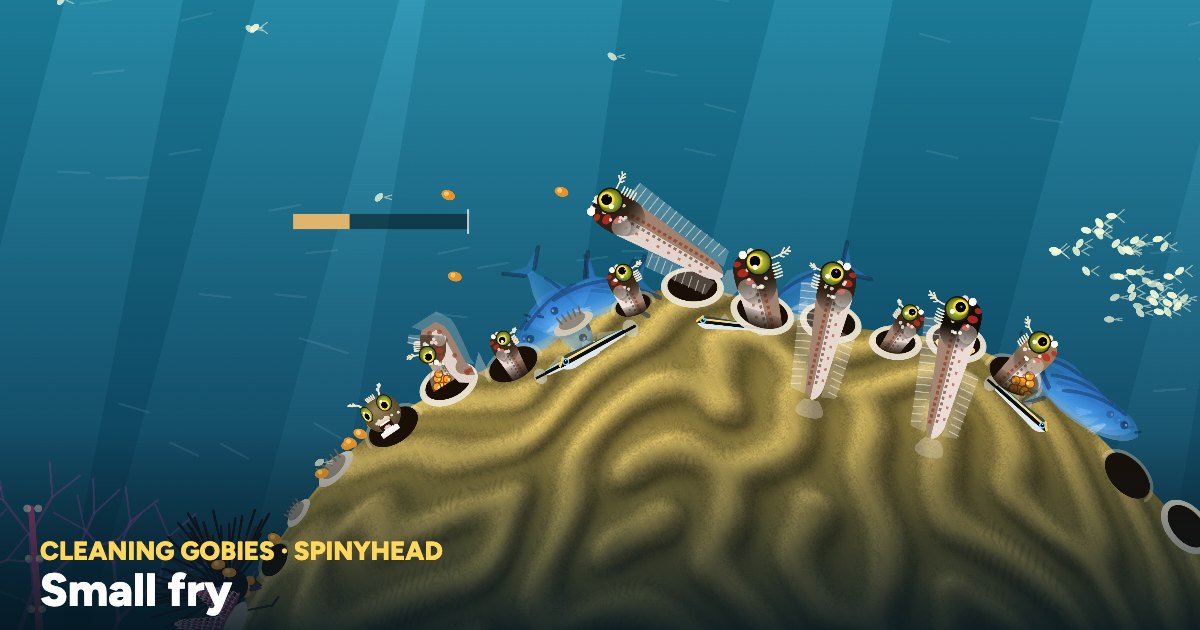
Behavior: Sex-specific (intrasexual) territorial aggression in a monogamous pair, a form of mate guarding, with both partners join
A small intruder is chased off by both members of the pair, whatever its sex. Only large intruders get the sex-specific treatment.
Species involved
- sharknose goby Elacatinus evelynae pair-forming cleaner goby that defends its territory and mate
About sex-specific (intrasexual) territorial aggression in a monogamous pair, a form of mate guarding, with both partners join
Many reef fishes live in socially monogamous pairs that share and defend a small territory. Residents often treat intruders differently depending on the intruder's sex and size. An adult of the same sex as a resident is a potential rival for the mate, so it tends to be met mostly by the resident of that sex. An intruder of the opposite sex may be tolerated or treated differently. Very small intruders are usually juveniles, which are not yet mating rivals. According to the game’s field notebook, both pair members chase them whatever their sex, and only large intruders get the sex-specific response.
Why it matters
Sex-specific aggression helps protect the pair bond and each partner's reproductive investment. It reduces the risk of losing a mate or sharing a partner's effort with a rival. Chasing small intruders by both partners probably protects shared resources such as space and food, and may protect the cleaning station. This is a reasonable interpretation rather than something the game’s notebook entry itself establishes. Together these responses help keep pairs stable, and that in turn shapes how individuals are spaced across the reef.
On coral reefs
A diver may see a pair of sharknose gobies at a cleaning station on a coral head or sponge. A resident will dart at an intruding goby and drive it off, sometimes with short chases or displays at the edge of the territory. Small gobies are often seen being chased by whichever resident is closer, while larger ones tend to be met by the resident of the matching sex.
Who studied it
The game’s source is Harding, Almany, Houck and Hixon (2003, Animal Behaviour 65:865). It is an experimental study of why monogamy occurs in the Caribbean cleaning goby, and it tested how residents respond to intruders of different sex and size. The wider question of why some marine fishes are monogamous, and whether mate guarding or other factors maintain pairs, has been reviewed for fishes in general. Cleaning gobies are a well-used study system for it.
Elsewhere in the animal kingdom
Same-sex aggression and mate guarding are widespread among pair-bonded animals. Many territorial birds, such as songbirds, chase same-sex intruders, and some burying beetles show comparable sex-specific defense of a shared resource. Among fishes, pair-forming butterflyfishes and some cichlids defend shared territories in a similar way.
Doubts and open questions
It is often hard to separate defense of the mate from defense of resources such as space, food or cleaning clients, since one behavior can serve both. How monogamy is maintained in fishes is still debated, with mate guarding, low mate availability and the benefits of sharing a territory all proposed.
Related behaviors
- mate guarding Here an individual stays close to its partner or repels rivals to secure paternity or the pair bond, whereas this entry also covers chasing small non-rivals.
- territorial defense This is aggression to protect space or resources regardless of the intruder's sex, which is how small intruders are treated here.
- cleaning symbiosis This is the service interaction in which gobies remove parasites from client fish, rather than aggression between gobies.
- social monogamy This describes the pair-living arrangement itself, not the aggressive behaviors that may help maintain it.
Spinyhead is a free game you play in your browser: you are a spinyhead blenny, a fish about 3 cm long living in a worm hole on a Caribbean coral head. Feed, fight for a better hole, court, raise eggs and dodge predators, while everything around you behaves the way field biologists have seen it behave. Most behaviors in the game come from published field studies; the rest are borrowed from other reefs or extrapolated, and this page says which. There are 71 on these pages, and more in the game’s field notebook waiting to be found.
More cleaning gobies
Other reef behaviors to discover