SpinyheadPlay free
A moray at the station
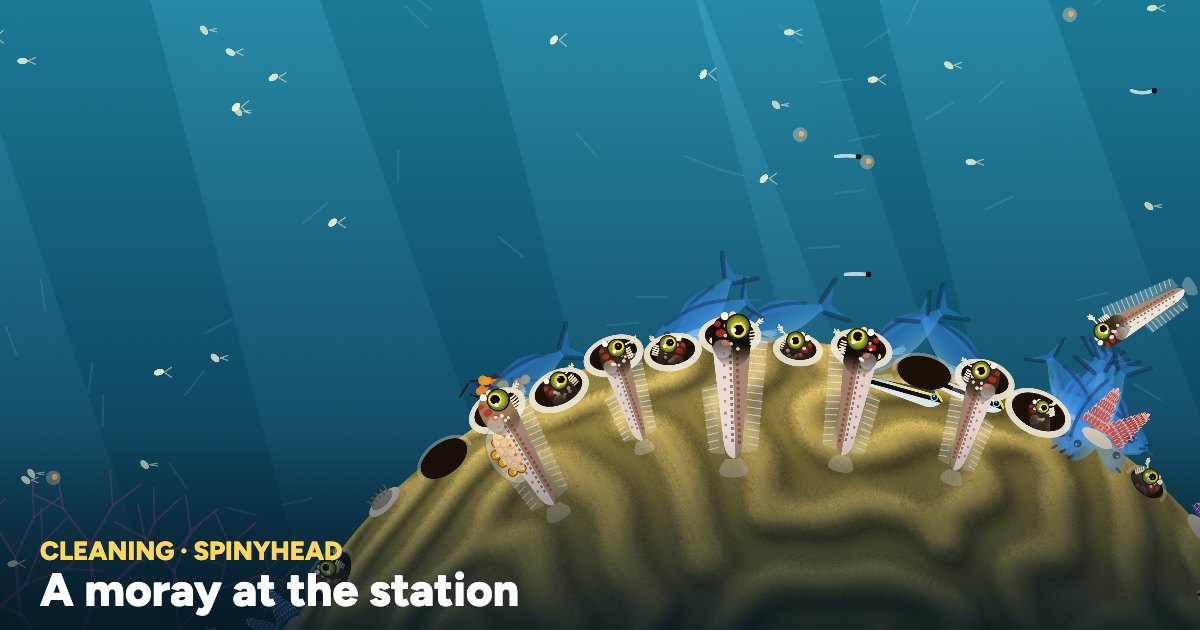
Behavior: Cleaning symbiosis (client posing at a cleaning station)
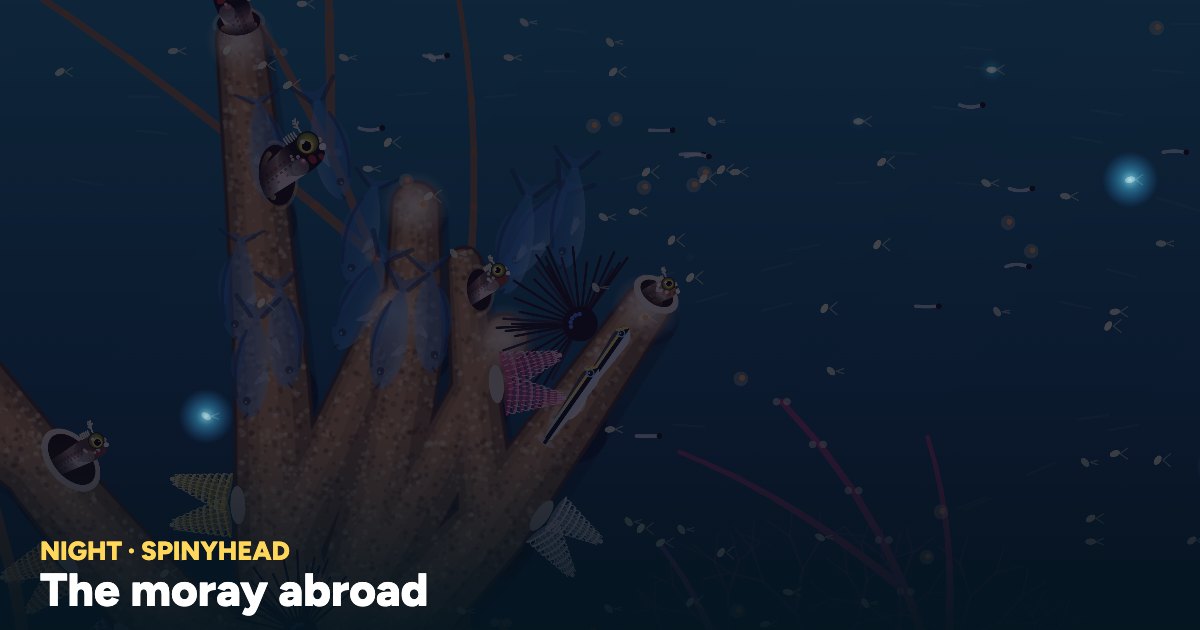
Even the moray comes to be cleaned, lying still with its mouth held open while the gobies work over its head and teeth.
Species involved
- spotted moray Gymnothorax moringa client posing with mouth open to be cleaned
- goldentail moray Gymnothorax miliaris possible client at cleaning stations
- sharknose goby Elacatinus evelynae cleaner removing parasites from head, gills and mouth
- parasitic copepods Copepoda parasites eaten by the cleaner
About cleaning symbiosis (client posing at a cleaning station)
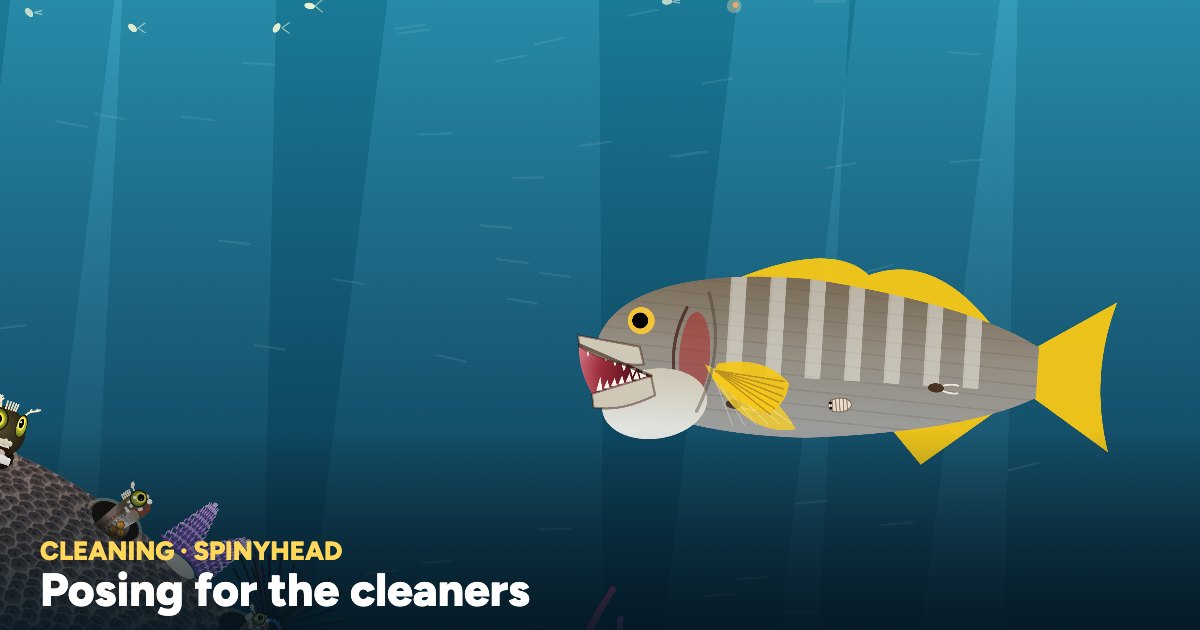
Cleaning symbiosis is a relationship in which a small cleaner animal removes parasites, mucus and damaged tissue from the body of a larger client fish. The cleaner gets a meal and the client gets relief from parasites. Clients visit fixed cleaning stations, often marked by a particular coral head or sponge, and typically signal their readiness to be cleaned by holding still in a characteristic posture. Posing can mean hovering head-up or head-down, spreading the fins, or opening the mouth and gill covers so the cleaner can reach inside.
Why it matters
For the cleaner, clients are a dependable food source, and in some cleaner gobies they make up a large part of the diet. For the client, cleaning reduces the load of external parasites such as gnathiid isopods and copepods, and it may help wounds stay clean. Predatory clients, including morays, refrain from eating their cleaners, which shows how strongly the interaction is stabilised. Cleaning stations also concentrate fish and may influence where and how long clients spend time on a reef, so they can shape local fish communities.
On coral reefs
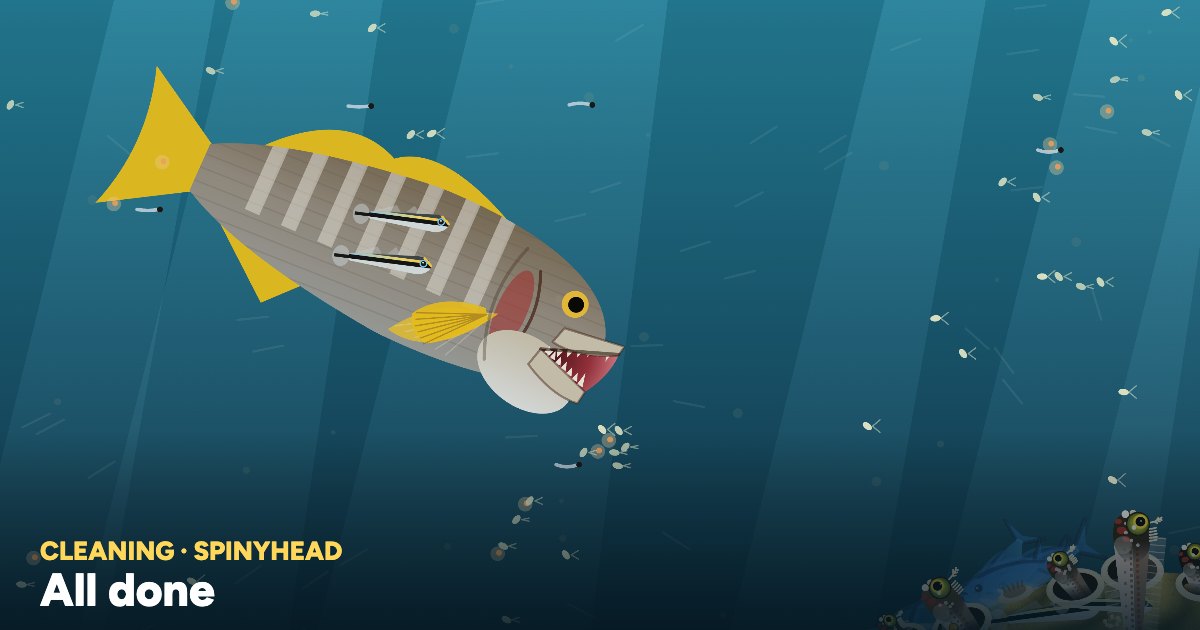
A diver may see a moray hanging in the open at a station, motionless, with its jaws gaping, while one or more small gobies crawl over its head, gill openings and even between its teeth. Gobies often perch on the client's body and may dart in and out of the mouth. The moray normally lies still rather than retreating to its crevice, and the cleaners are not attacked.
Who studied it
Cleaning behavior was noted by naturalists for a long time, and was studied systematically from the 1950s and 1960s onward, including on Caribbean reefs. Later work, much of it on Indo-Pacific cleaner wrasses and on Caribbean cleaner gobies and shrimps, tested whether cleaners really lower parasite loads and how clients and cleaners negotiate the interaction.
Elsewhere in the animal kingdom
Cleaning occurs across the oceans and in freshwater. The best-known cleaners are the cleaner wrasses (Labroides) of the Indo-Pacific, cleaner shrimps such as Pederson's cleaner shrimp, and cleaner gobies of the Caribbean. Similar interactions occur on land, for example oxpeckers on large African mammals, although how much they benefit their hosts is debated.
Doubts and open questions
Researchers still debate how much cleaning truly benefits clients, since studies measuring effects on parasite loads have given mixed results. It is also debated whether cleaners sometimes cheat by eating client mucus or tissue instead of parasites, and how clients police this. Whether moray species routinely visit gobies is less well documented than for other clients, so this scene is best read as a plausible example of posing rather than a thoroughly measured one.
Related behaviors
- Mutualism The broader category of interactions that benefit both partners, of which cleaning is one example.
- Aggressive mimicry A false cleaner mimics a cleaner to bite the client instead of helping it.
- Cleaning by shrimp Cleaner shrimps such as Pederson's cleaner shrimp do similar work with different body plans and signals.
- Commensalism One species benefits while the other is neither helped nor harmed, unlike cleaning where both gain.
Spinyhead is a free game you play in your browser: you are a spinyhead blenny, a fish about 3 cm long living in a worm hole on a Caribbean coral head. Feed, fight for a better hole, court, raise eggs and dodge predators, while everything around you behaves the way field biologists have seen it behave. Every behavior in the game is backed by a published study or careful observation; there are 38 on these pages, and more in the game’s field notebook waiting to be found.
More cleaning
Other reef behaviors to discover