 SpinyheadPlay free
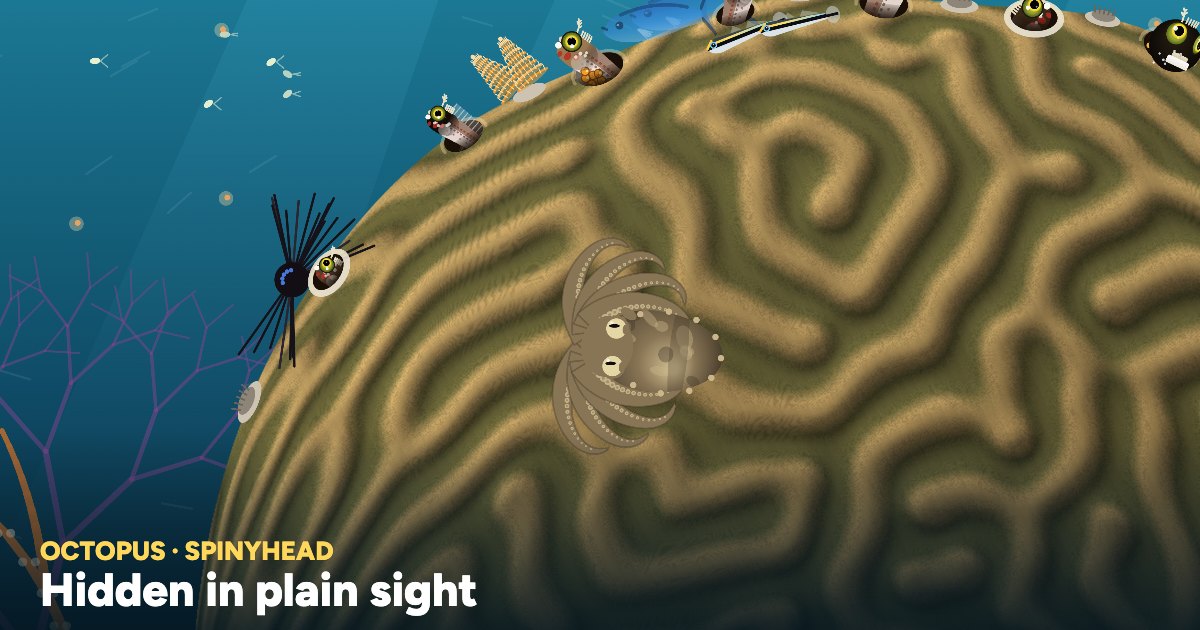
Hidden in plain sight
Behavior: Camouflage (adaptive body patterning, crypsis and background matching)
An octopus can match the coral in an instant: mottled skin, raised papillae, arms tucked in. It sits and waits for prey to come within reach.
Species involved
- common octopus Octopus vulgaris camouflaged ambush predator that changes skin colour, pattern and texture
About camouflage (adaptive body patterning, crypsis and background matching)
Camouflage, or crypsis, is any combination of colour, pattern, texture and posture that makes an animal hard for other animals to detect or recognise. Octopuses do this very rapidly. Their skin contains chromatophores (pigment organs controlled by muscles and nerves), reflective cells such as iridophores and leucophores, and muscular papillae that can raise the skin into bumps and spikes. Together these let an octopus alter its apparent colour, pattern and surface texture within a second or two. Tucking the arms in and flattening or hunching the body also breaks up the animal's outline.
Why it matters
Camouflage lowers the chance of being spotted by predators such as fishes, moray eels and sharks, and by prey that would flee if they saw a hunter approaching. For an octopus, which has no shell and a soft, nutritious body, this is a main line of defence. Sitting still and blending in lets it wait until a crab, shrimp or small fish comes within reach, so it spends little energy on chasing. It is also cheap compared with fighting or fleeing. The octopus's colour vision is thought to be limited, so how it matches backgrounds so well is still being studied.
On coral reefs
A diver usually sees a rock-like or coral-like lump, often at the mouth of a crevice or den, with mottled or banded skin and a rough, bumpy texture. Often the animal is only noticed when it moves, flashes a different pattern or jets away, sometimes leaving a cloud of ink. Octopuses may change colour and texture again as they move across sand, rubble or live coral.
Who studied it
Naturalists have long marvelled at cephalopod colour change, and it has been studied in detail by experimental and behavioural biologists. The notebook cites Hanlon and Messenger's 1996 book Cephalopod Behaviour, a standard reference that describes how cephalopods use body patterns for camouflage and communication. Their work helped classify the main types of camouflage body pattern (uniform, mottled and disruptive) that cephalopods use.
Elsewhere in the animal kingdom
Camouflage is widespread across animals. Among cephalopods, cuttlefish and squid are also famous for rapid colour change. Other well-known examples include chameleons, flatfishes such as flounders, stonefish and frogfish on reefs, stick insects and leaf-mimicking katydids, and arctic hares or ptarmigan with seasonal coats.
Doubts and open questions
A continuing question is how octopuses and cuttlefish match their backgrounds so well when their eyes appear to have only one visual pigment and so probably lack conventional colour vision. Suggestions include that the skin itself senses light, or that the eye uses other cues, but this is not settled. Researchers also debate how much of a pattern is chosen by the animal in response to its surroundings and how much is a fixed response to certain visual features.
Related behaviors
- aggressive mimicry The predator resembles something harmless or attractive to lure prey, rather than simply blending in with the background.
- mimicry of other animals The animal imitates another species, such as a venomous one, instead of matching the background.
- disruptive coloration High-contrast patches break up the body outline; this is one specific camouflage tactic.
- deimatic (startle) display The animal suddenly reveals conspicuous markings to startle a predator instead of hiding.
Spinyhead is a free game you play in your browser: you are a spinyhead blenny, a fish about 3 cm long living in a worm hole on a Caribbean coral head. Feed, fight for a better hole, court, raise eggs and dodge predators, while everything around you behaves the way field biologists have seen it behave. Every behavior in the game is backed by a published study or careful observation; there are 14 on these pages, and more in the game’s field notebook waiting to be found.
Other reef behaviors to discover