 SpinyheadPlay free
Night grazer
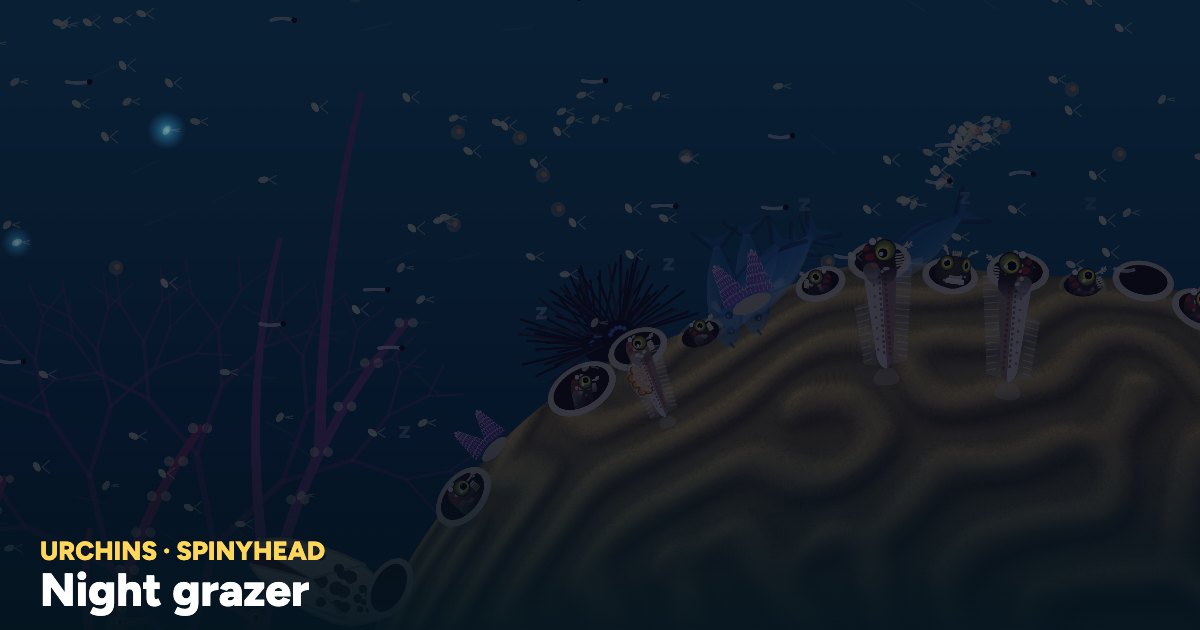
Behavior: Nocturnal grazing (herbivory) by Diadema antillarum, and the grazing-driven control of reef algae
The long-spined sea urchin Diadema antillarum shelters by day and comes out at night to graze algae off the reef. A mass die-off in 1983–84 killed most of them across the Caribbean, and algae spread over many reefs.
Species involved
- long-spined sea urchin Diadema antillarum nocturnal algal grazer, key herbivore
- brain coral reef-builder affected by algal overgrowth
- great star coral Montastraea cavernosa reef-builder affected by algal overgrowth
- massive starlet coral Siderastrea siderea reef-builder affected by algal overgrowth
- elkhorn coral Acropora palmata reef-builder affected by algal overgrowth
About nocturnal grazing (herbivory) by diadema antillarum, and the grazing-driven control of reef algae
Nocturnal grazing is a daily activity rhythm in which an herbivore hides in shelter by day and feeds in the open at night. Diadema antillarum rests in crevices and under ledges during daylight, then emerges after dusk and scrapes algae and algal films from the reef surface with its mouthparts. Because it feeds on the reef framework itself, it removes algae that would otherwise grow over hard surfaces. The notebook entry also records the mass die-off of 1983-84, when most of these urchins were lost across the Caribbean.
Why it matters
By hiding by day the urchin lowers its exposure to visual predators, and by grazing at night it still reaches its food. Where urchins are dense, their grazing keeps algae short and leaves bare space on which coral larvae can settle and young corals can survive. When most Diadema died in 1983-84, algae spread over many reefs, which shows how much of the grazing the species had been doing. Algal cover that persists can crowd out coral recruits and shift a reef from coral dominated toward algae dominated. Fish herbivores also graze, so the urchin's importance depends on how many of them remain, and overfishing of grazing fish is thought to have increased that dependence.
On coral reefs
By day a diver usually sees only long black spines poking out of crevices and from under ledges, often in groups. After dark the urchins move out over the reef, and their grazing leaves cropped, clean-looking patches. On reefs where Diadema is still scarce, algae-covered surfaces are common and urchins are rare in daylight.
Who studied it
The notebook cites Lessios 1988 in Annual Review of Ecology and Systematics, a review of the Diadema mass mortality of 1983-84. That review described how the die-off spread across the Caribbean and what it did to reefs. Lessios was a leading researcher of this event. The event is one of the best-known cases of disease affecting a key reef species. The cause was never conclusively identified at the time, although later work has pointed to a pathogen.
Elsewhere in the animal kingdom
Grazing sea urchins with strong effects on algae occur in many seas. Sea urchins in temperate kelp forests, where heavy grazing can create barren areas, are a well-known example. On reefs in other regions, parrotfish and surgeonfish are classic herbivores that control algae. Night-time activity with daytime shelter is also common in many other invertebrates and fishes.
Doubts and open questions
Scientists still discuss how much the loss of Diadema, relative to overfishing of herbivorous fishes and to nutrient pollution, explains algal takeover of Caribbean reefs. Recovery of Diadema has been patchy and slow in many places, and the reasons for this are not fully settled.
Related behaviors
- diurnal grazing by parrotfish and surgeonfish These fishes also remove algae from reefs but feed by day rather than at night.
- bioerosion Grazers can wear down reef rock as they feed, whereas this entry concerns mainly the control of algae.
- trophic cascade This is a wider idea in which changes at one feeding level ripple through the community, and the Diadema die-off is often described as an example.
Spinyhead is a free game you play in your browser: you are a spinyhead blenny, a fish about 3 cm long living in a worm hole on a Caribbean coral head. Feed, fight for a better hole, court, raise eggs and dodge predators, while everything around you behaves the way field biologists have seen it behave. Every behavior in the game is backed by a published study or careful observation; there are 14 on these pages, and more in the game’s field notebook waiting to be found.
Other reef behaviors to discover