 SpinyheadPlay free
Great star coral Montastraea cavernosa
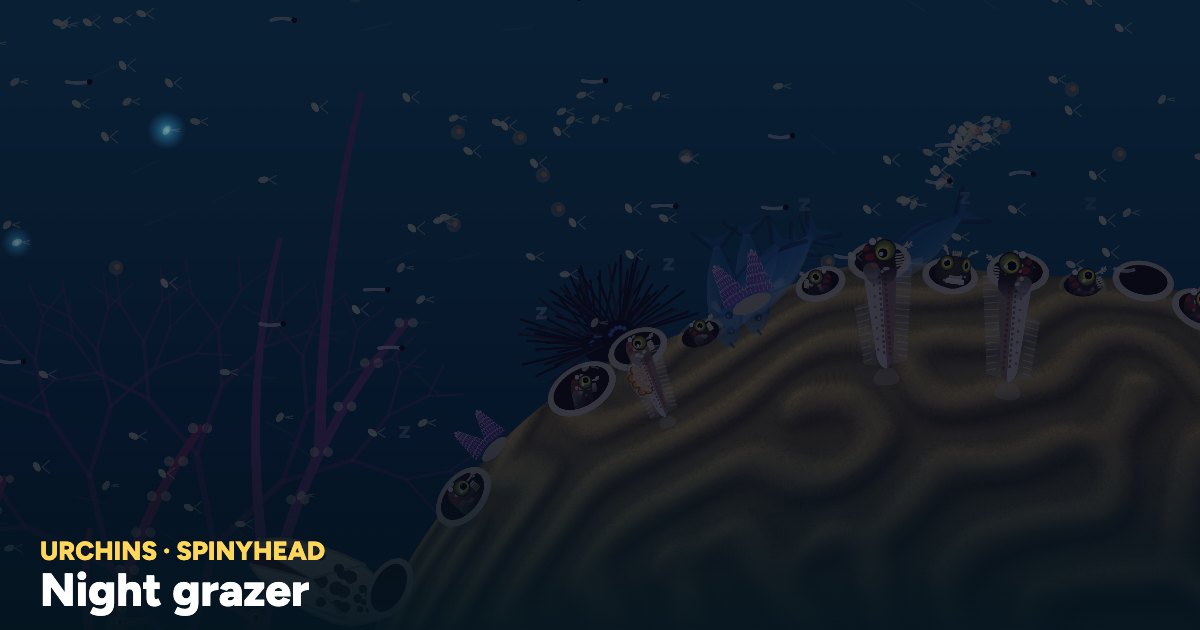
The great star coral is a massive, boulder-forming stony coral that builds rounded heads, domes, or sometimes flattened plates and crusts on Caribbean reefs. Its polyps are unusually large for a reef-building coral, and each sits in a rounded cup (corallite) with a raised rim, giving the surface a bumpy, cobbled look. It is a hardy, long-lived species that tolerates a wide range of light and turbidity, so it is common from shallow reef flats to deep fore-reef slopes. Colonies range from brown, tan, and green to gray, and polyps may glow with fluorescent green or orange pigments. At night the polyps extend their tentacles to feed, making the colony look fuzzy.
How to recognize it
- large round polyps with raised rims
- corallites about 5 to 6 mm across
- corallites spaced apart with ridged skeleton between them
- massive mounds or plates
- polyps extended at night
- brown, tan, or greenish color
- often fluorescent green or orange mouths
| Size | Colonies are commonly tens of centimeters to about 1 meter across. Large old colonies can reach a few meters in diameter. |
|---|---|
| Range | Tropical western Atlantic, including Florida, the Bahamas, the Gulf of Mexico, and the Caribbean Sea, south to Brazil. A related or similar form occurs in the eastern Atlantic, including West Africa and Atlantic islands. |
| Habitat | Found on reef slopes, walls, patch reefs, and reef flats, and on ledges and overhangs. It is common from very shallow water to deep reefs, with a depth range of roughly 1 m to over 100 m. It is one of the more abundant corals on deeper, lower-light reefs. |
| Diet | Gets much of its energy from symbiotic algae (zooxanthellae) in its tissue, which photosynthesize. It also actively captures zooplankton and other small particles with its tentacles, mostly at night. It can feed heavily on plankton, which helps it survive in deep or turbid water where light is poor. |
| Conservation | Not currently listed as threatened under the US Endangered Species Act, and the IUCN lists it as Least Concern. It is vulnerable to coral bleaching, disease including stony coral tissue loss disease, which has affected it in some areas, sedimentation, pollution, and damage from boats and anchors. It is considered relatively resilient compared with many other Caribbean corals. |
Life and behavior
Colonies grow slowly, adding a few millimeters to about a centimeter or so per year, and large colonies may be many decades to centuries old. The species is mostly a broadcast spawner: colonies are separate sexes and release eggs and sperm into the water, typically in a synchronized event in late summer after the full moon. Larvae drift in the plankton before settling and forming new colonies. Colonies can also spread by fragmentation. Like other corals it competes with neighbors for space using extended digestive filaments.
Its family: Montastraeid corals (Montastraeidae)
Members are massive, reef-building stony corals with large rounded or polygonal corallites. They host symbiotic algae and form boulder-like or encrusting colonies. Family classification has been revised in recent years, so some references place this species in a different family.
Similar species
- Mountainous star coral Orbicella faveolata Has much smaller polyps, with a smoother surface and corallites only a few millimeters across, and forms larger mounds or plates with ridges.
- Boulder star coral Orbicella annularis Has much smaller corallites and often grows in columns or lobes, while the great star coral has noticeably larger cups.
- Symmetrical brain coral Pseudodiploria strigosa Forms winding valleys and ridges instead of separate round cups.