 SpinyheadPlay free
Courtship
Behavior: Courtship display (male courtship signalling, sexual display)
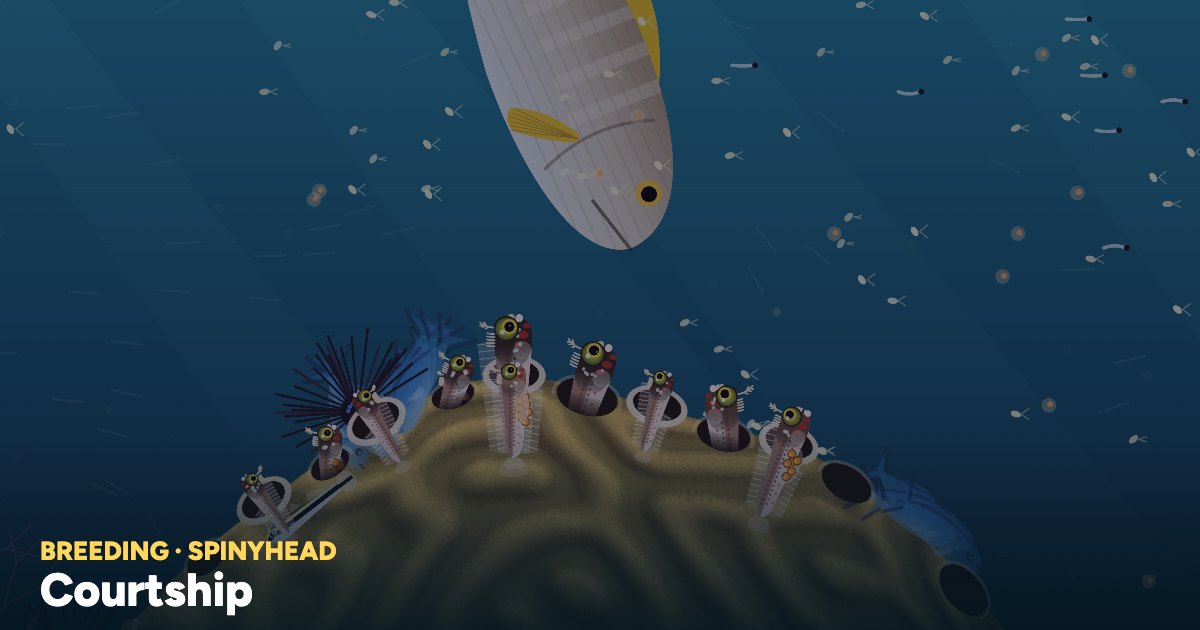
A courting male signals from his hole: his head turns dark, he bobs and lunges and raises his fin, showing off to passing females.
Species involved
- spinyhead blenny Acanthemblemaria spinosa courting male displaying from his hole to visiting females
About courtship display (male courtship signalling, sexual display)
Courtship is a set of conspicuous signals that one sex, usually the male, gives to attract a mate and to show he is ready to spawn. In many fishes the signals combine colour change, stereotyped movements and the spreading of fins. The spinyhead blenny is a small tube blenny that lives in empty holes in reef rock or coral skeleton. The male stays at his hole entrance and displays from there instead of swimming off to find a mate. Females come to him. The notebook describes a darkened head, bobbing, lunging and a raised fin.
Why it matters
Courtship lets a female recognise a male of her own species who is ready to breed and, potentially, compare males. For the male, a good display can mean more spawnings. In blennies of this kind the hole probably doubles as the nest, so the display also advertises the nest site. Success in courtship therefore feeds into reproductive success, and into which males and which holes contribute most to the next generation. Because the display is costly and conspicuous, it must be balanced against the risk of attracting predators and against the time spent not feeding.
On coral reefs
A diver who looks closely at a patch of reef rock may see a small fish with its head and front of the body projecting from a hole. A courting male looks darker around the head. He repeatedly bobs or darts forward out of the hole and spreads his dorsal fin. The display is brief and subtle, easy to miss without close, patient watching, and the fish retreats into the hole at the first sign of danger.
Who studied it
Courtship displays in fishes were a classic subject of early ethology and of sexual selection theory, which asks why showy signals evolve. Tube blennies (Chaenopsidae) have been studied on Caribbean reefs mainly for their territoriality, habitat use and reproduction. The notebook's source for this entry is Clarke & Tyler 2003, Copeia 2003:241, which I cannot summarise in more detail with confidence.
Elsewhere in the animal kingdom
Male courtship displays from a territory or nest are widespread in fishes. Examples include the zigzag dance of male three-spined sticklebacks and the signal jumps of male damselfishes over their nests. Some cichlids and many gobies also show courtship colouring and fin displays. Outside fishes, the best-known examples are the displays of birds such as birds-of-paradise and peacocks.
Doubts and open questions
It is often unclear whether such displays are aimed mainly at females, at rival males, or both, since dark colouring and fin-raising also appear in aggressive encounters. How far females actually choose among males based on these signals, and which signal features they use, is hard to test and varies among species.
Related behaviors
- territorial aggression display uses similar signals such as darkening and fin-raising, but is directed at rival males to defend the hole rather than at females to attract a mate.
- paternal egg guarding is the care a male gives to eggs after spawning, whereas courtship comes before spawning and aims to obtain the mating.
- mate guarding is a male keeping close to a female to stop rivals mating with her, rather than advertising to attract her.
- lek mating involves males displaying together in a cluster for females to choose among, rather than from separate individual holes.
Spinyhead is a free game you play in your browser: you are a spinyhead blenny, a fish about 3 cm long living in a worm hole on a Caribbean coral head. Feed, fight for a better hole, court, raise eggs and dodge predators, while everything around you behaves the way field biologists have seen it behave. Every behavior in the game is backed by a published study or careful observation; there are 14 on these pages, and more in the game’s field notebook waiting to be found.
More breeding
Other reef behaviors to discover