 SpinyheadPlay free
Common octopus Octopus vulgaris

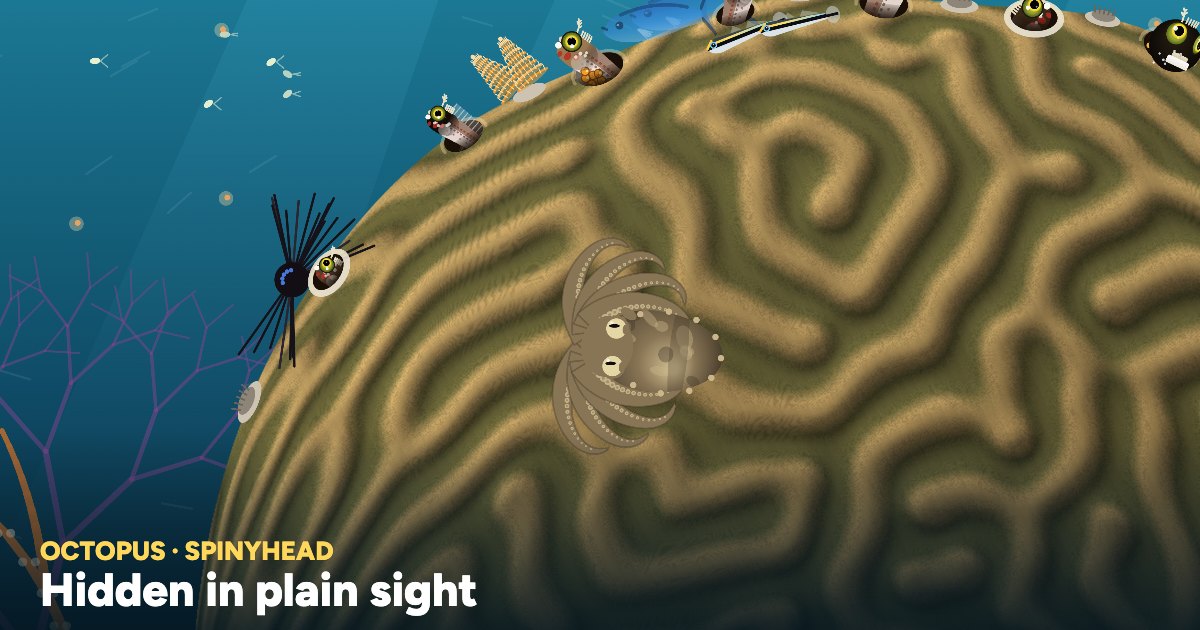
The common octopus is a medium to large, soft-bodied, bottom-dwelling cephalopod with a baggy oval body, a large head, and eight long arms. It is a solitary, mostly shallow-water hunter that is famous for its intelligence, problem-solving, and camouflage. Within seconds it can change colour, pattern, and skin texture to match rock, algae, or sand. Taxonomists now treat O. vulgaris as a complex of closely related species, and Caribbean animals called 'common octopus' may belong to a different species in this group. By day it usually stays hidden in a den and is seen mainly at dawn, dusk, and night.
How to recognize it
- eight arms with two rows of suckers
- no fins on the rounded mantle
- large eyes with horizontal pupils
- skin covered in small bumps and papillae
- colour changes from mottled brown, grey, or red to nearly white
- arms long and fairly equal in length
- pile of shell and crab debris at den entrance
| Size | Typically a mantle length of about 10-20 cm and a total length of about 60-100 cm. Mantle length can reach about 25 cm. Weights are usually a few kg at most, and Mediterranean and Atlantic animals are |
|---|---|
| Range | Traditionally reported from warm temperate and tropical seas worldwide, including the eastern and western Atlantic. Records from different oceans are uncertain because several look-alike species have been lumped together under this name. |
| Habitat | Rocky reefs, reef crevices, rubble, seagrass beds, and sandy patches near shelter. It lives in dens in holes, under ledges, or in empty shells, and it is reported from the intertidal zone to deeper than 100 m. It is most often seen in shallow water. |
| Diet | A carnivore that eats mainly crabs, lobsters and other crustaceans, and also snails, clams, and small fish. It pounces on prey, wraps it in its arms and web, and bites with a hard beak. It can drill through shells with its radula and a salivary papilla, and it injects saliva containing toxins that subdue and soften prey. |
| Conservation | Octopus vulgaris is assessed by the IUCN as Least Concern, but the assessment is complicated by the uncertain identity of populations in the species complex. It is heavily fished in some regions, including the Mediterranean and West Africa. Its short life and dependence on one breeding season make populations sensitive to overfishing and to environmental change. |
Life and behavior
The common octopus is solitary and keeps a den that it defends and returns to after hunting trips. When threatened it can change colour, jet away, release a cloud of ink, or squeeze into tiny gaps. Males transfer sperm packets with a modified third right arm. A female lays many thousands of small eggs in strings hung inside her den, and she guards, cleans, and aerates them without feeding. Eggs take roughly one to two months to hatch, depending on temperature. The tiny young drift as plankton before settling to the bottom. Both sexes live only about one to two years, and females typically die soon after their eggs hatch.
Its family: Octopuses (Octopodidae)
Octopodidae is the largest family of octopuses. Its members have eight arms with suckers in two rows, a rounded finless body, and a beak. They are mostly bottom dwellers that hide in dens, can change colour and texture, and are short-lived. Most species die after breeding, and the female guards her eggs.
Similar species
- Caribbean reef octopus Octopus briareus Usually has a blue-green or bluish tint and is often active at night. It also tends to look smoother and more iridescent than the common octopus.
- Atlantic longarm octopus Macrotritopus defilippi Lives over open sand and seagrass rather than in reef dens. It is slender with very long arms and can mimic a flatfish while swimming.
- White-spotted octopus Callistoctopus macropus Typically reddish with obvious white spots and long, thin arms. The common octopus is more variable in colour and has no consistent white spots.