SpinyheadPlay free
A clutch hatches
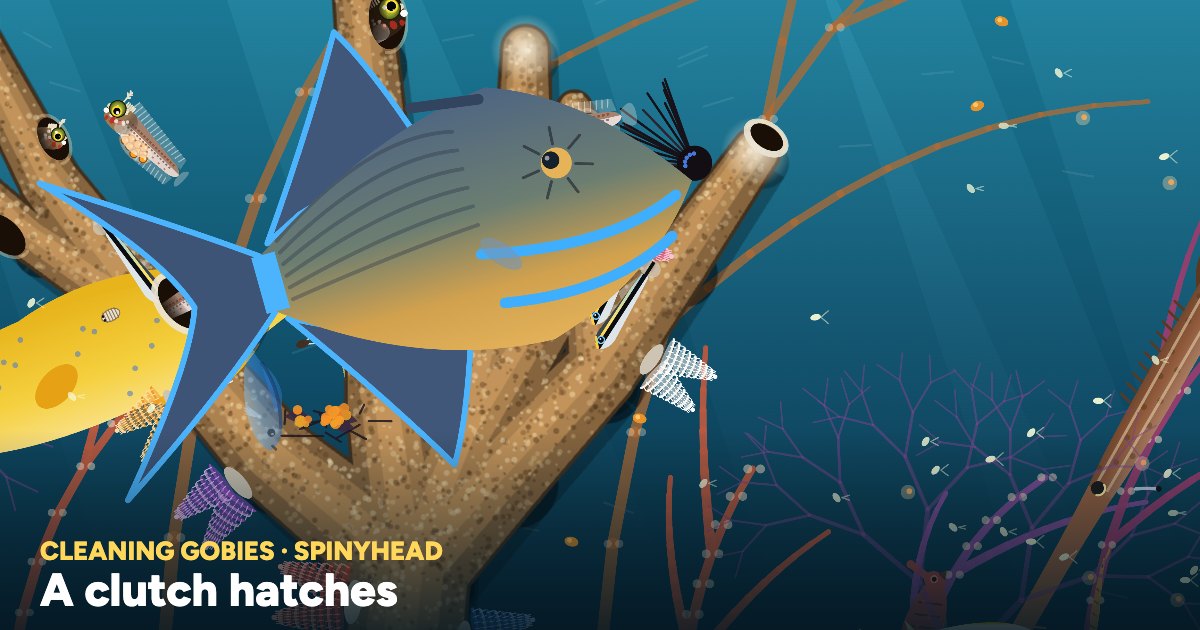
Behavior: Paternal egg care (male brood care) with nocturnal synchronized hatching
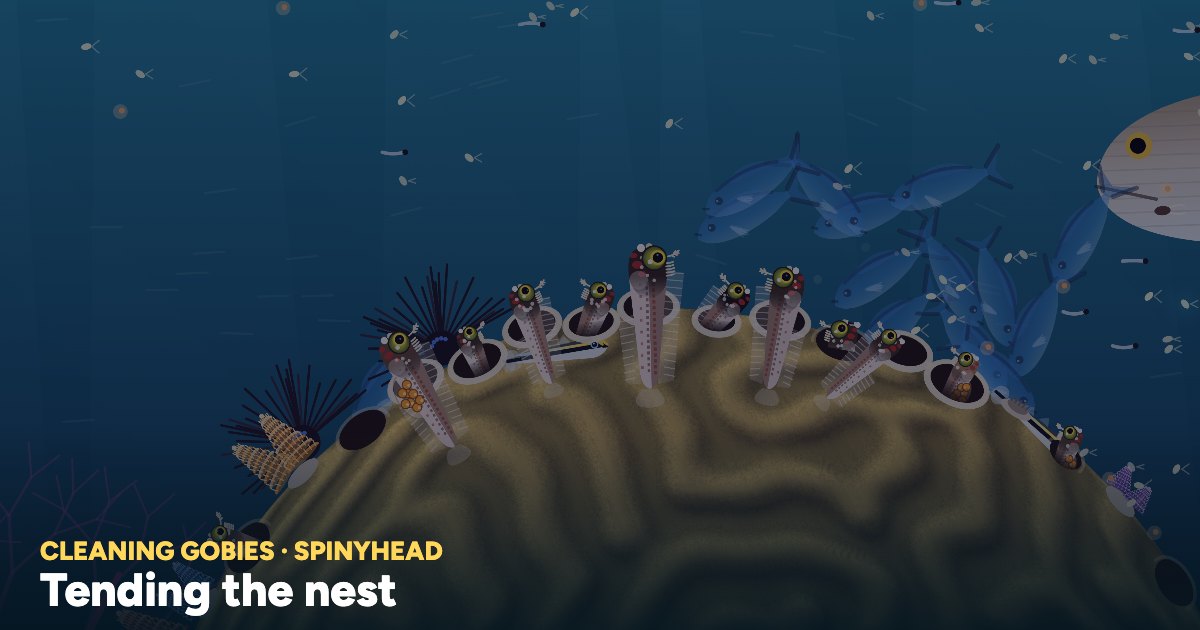
A clutch is usually about 250 eggs, up to 500 or 600 from a big female, each in a clear 2 mm capsule glued to the roof of the crevice. The male fans and tends them for about a week, and they hatch after sunset, when the day’s predators have gone to cover.
Species involved
- sharknose goby Elacatinus evelynae male guards, fans and tends the demersal clutch; female lays it
About paternal egg care (male brood care) with nocturnal synchronized hatching
Paternal care means the male alone guards and looks after the eggs until they hatch. In many small reef fishes the female lays a clutch of adhesive eggs on a hard surface, often inside a crevice or shelter, and the male stays with it. He fans the eggs with his fins to keep them supplied with oxygenated water and removes debris and dead eggs, and he drives off egg-eating intruders. Eggs of this kind are called demersal, meaning they stay attached to the substrate instead of drifting. The notebook describes sharknose goby eggs as small clear capsules glued to the roof of the crevice, tended for about a week before hatching after sunset.
Why it matters
Egg care raises the proportion of eggs that survive, since unguarded clutches are easily eaten and can suffocate or become fouled. For the male it costs foraging and mating time, so the trade-off is worth it only if guarding increases his reproductive success. Larger females lay larger clutches, so a male's investment is tied to female size. Hatching after dark limits exposure of the tiny, weakly swimming larvae to visually hunting planktivores at the moment they leave the shelter. After hatching, the larvae drift in the plankton, which spreads offspring among reefs and links local populations. They also become part of the plankton food web.
On coral reefs
A diver would rarely see the eggs, because they are tiny, clear and hidden in a crevice or similar shelter. What can be seen is a goby that stays close to its shelter and may spend time inside it, and sometimes a pair living together at a cleaning station. Hatching takes place after sunset, when divers are generally not in the water.
Who studied it
Paternal care in fishes has long been studied as a model for the evolution of parental investment, and demersal-spawning gobies and blennies have been used extensively in such work. For the sharknose goby, the notebook cites Olivotto et al. 2005 in Aquaculture, a study of the species' reproduction and larval rearing in captivity, and Moe 2011 in Advanced Aquarist, an aquarium-keeping source. Much of what is known about clutch size, incubation and hatching timing in this species comes from captive breeding rather than field observation.
Elsewhere in the animal kingdom
Male-only egg care is common in bony fishes. Well-known examples include sticklebacks, which guard a nest and fan the eggs, damselfishes and clownfishes, which tend eggs laid on the substrate, and seahorses and pipefishes, in which the male carries the brood. Mouthbrooding in some cichlids and cardinalfishes is another form, and in some of these the male carries the eggs in his mouth.
Doubts and open questions
Numbers such as clutch size and incubation time come largely from captive animals, and wild values may differ with water temperature, female size and food. How much the male's fanning and cleaning each contribute to survival, versus simple defence, is difficult to separate in the field. Male care in some fishes is also linked to filial cannibalism, in which males eat part of the clutch.
Related behaviors
- filial cannibalism The guarding male eats some of his own eggs, instead of only protecting them.
- mouthbrooding The parent carries the eggs in the mouth instead of guarding them on a surface.
- male pregnancy In seahorses and pipefishes the eggs develop in a brood pouch on the male's body.
- broadcast spawning Eggs are released into open water with no parental care, as in bluehead wrasse.
Spinyhead is a free game you play in your browser: you are a spinyhead blenny, a fish about 3 cm long living in a worm hole on a Caribbean coral head. Feed, fight for a better hole, court, raise eggs and dodge predators, while everything around you behaves the way field biologists have seen it behave. Every behavior in the game is backed by a published study or careful observation; there are 38 on these pages, and more in the game’s field notebook waiting to be found.
More cleaning gobies
Other reef behaviors to discover