 SpinyheadPlay free
The trigger
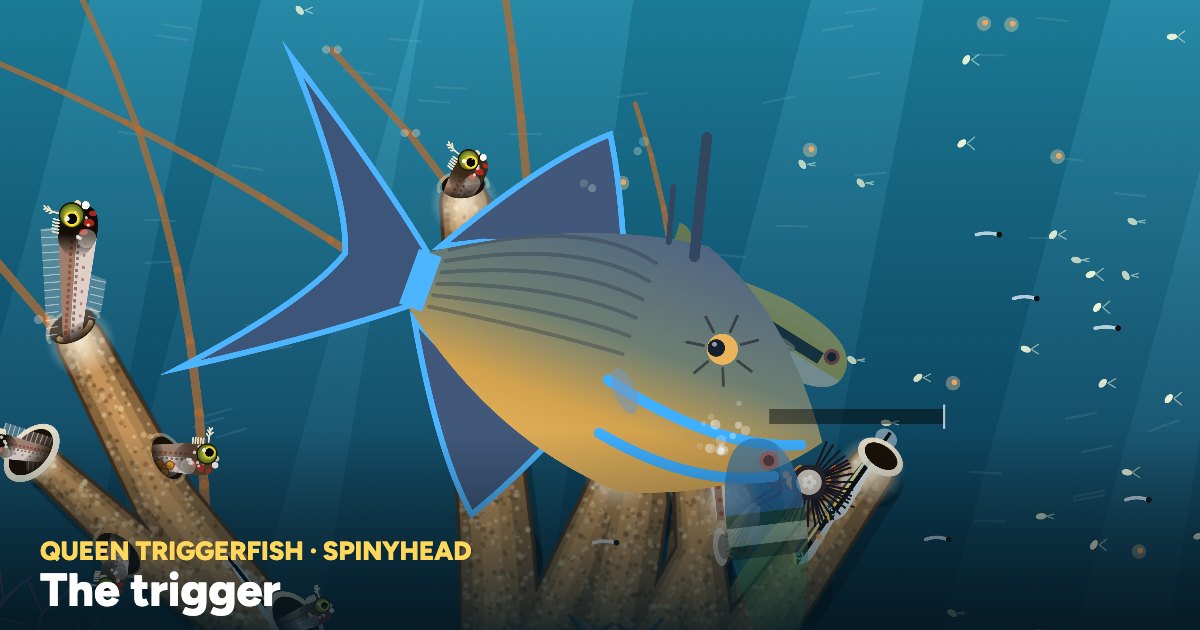
Behavior: Wedging behaviour (spine-locking anti-predator defence) in triggerfishes
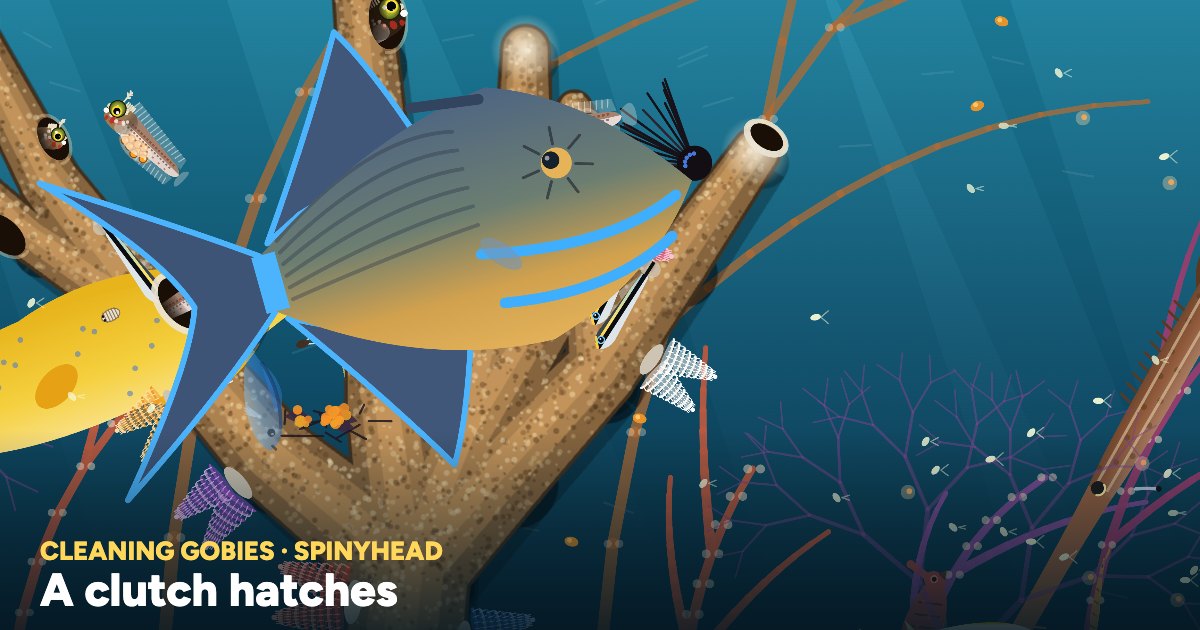
Threatened, a triggerfish dives into a crevice and raises its first dorsal spine; the small second spine locks it upright, pressing the second, the “trigger”, releases it,. Wedged in, it is almost impossible to pull out.
Species involved
- queen triggerfish Balistes vetula wedges itself into a crevice using its locking dorsal spine
About wedging behaviour (spine-locking anti-predator defence) in triggerfishes
Triggerfishes (family Balistidae) have a dorsal fin whose first spine is large and stout, and which can be raised and locked upright by the much smaller second spine. The second spine acts as the 'trigger' that gives the family its name: the first spine stays rigid until the second is depressed, which releases it. When threatened, a triggerfish retreats into a crevice or hole and erects the spine, wedging its body in place. The result is a fish that is very hard to dislodge, and also awkward for a predator to swallow while the spine is up.
Why it matters
The behaviour is a passive defence that combines a refuge with a mechanical lock. For the individual, it turns a hole in the reef into a place where it is hard to extract, which matters at night or when a predator is close. Many predatory fishes swallow prey whole or tear it out of cover, and an erect, locked spine works against both. The cost is that the fish is committed to one spot while wedged. Over time, this kind of defence probably reduces the number of triggerfish taken by predators that hunt close to the reef. It also makes reef structure with suitable crevices important for their survival.
On coral reefs
A diver who approaches a triggerfish near the reef may see it dart head-first into a crevice or under a ledge, with the dorsal spine often visible as it is raised. Once it is wedged, pulling it out is very difficult. Triggerfishes also shelter in the reef at night, and some can be seen resting wedged in place, though what a diver sees depends on the species and the habitat.
Who studied it
The locking dorsal spine mechanism is a well-known anatomical feature of triggerfishes and is the origin of the family's common name. It has long been described in fish anatomy and in field guides, which note that the fish uses it to lock itself into holes.
Elsewhere in the animal kingdom
Locking spines are found in other fishes. Filefishes (Monacanthidae), close relatives of triggerfishes, have a similar locking first dorsal spine. Some other fishes, such as certain catfishes, can lock their spines in an erect position, and pufferfishes and porcupinefishes use inflation and spines to become hard to swallow. Many reef fishes also wedge into crevices, but the spine lock is what distinguishes triggerfishes.
Doubts and open questions
How much the locked spine protects against different predators is not fully measured in the wild, and the notebook does not claim otherwise. Wedging is probably one of several defences, along with speed, tough skin and schooling or sheltering behaviour, and how they combine is not clear.
Related behaviors
- Inflation defence Pufferfishes swell their bodies with water or air to become too large to swallow, rather than locking a spine into a crevice.
- Crevice sheltering Many reef fishes simply hide in holes without a mechanical lock, so they can be pulled out more easily.
- Spine erection defence Fishes such as lionfish or squirrelfish raise spines to deter predators but do not wedge themselves in place.
Spinyhead is a free game you play in your browser: you are a spinyhead blenny, a fish about 3 cm long living in a worm hole on a Caribbean coral head. Feed, fight for a better hole, court, raise eggs and dodge predators, while everything around you behaves the way field biologists have seen it behave. Every behavior in the game is backed by a published study or careful observation; there are 38 on these pages, and more in the game’s field notebook waiting to be found.
More queen triggerfish
Other reef behaviors to discover