SpinyheadPlay free
Anything that bites
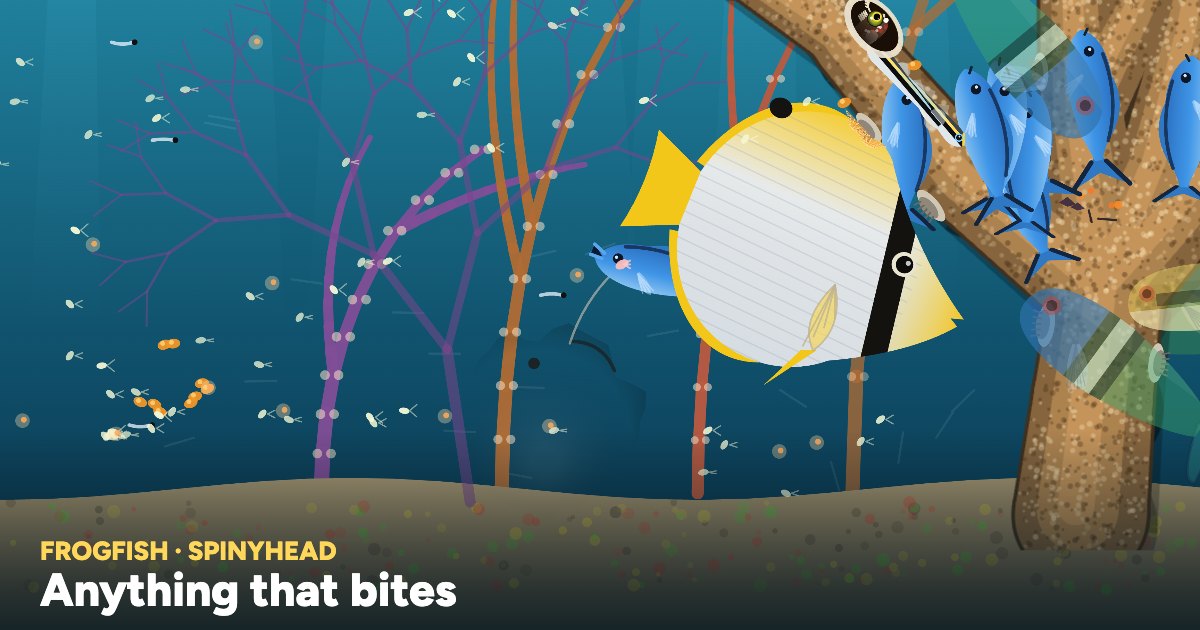
Behavior: Aggressive mimicry (angling, or lure-based ambush predation)
A frogfish takes whatever comes within reach of its mouth: chromis and grunts that swim over to inspect the lure, a wrasse that darts at it, a goby, a shrimp.
Species involved
- longlure frogfish Antennarius multiocellatus sit-and-wait ambush predator that wiggles a lure
- blue chromis Chromis cyanea potential prey that approaches to inspect the lure
- French grunt Haemulon flavolineatum juvenile potential prey that approaches the lure
- bluehead wrasse Thalassoma bifasciatum potential prey that strikes at the lure
- sharknose goby Elacatinus evelynae small potential prey within reach
- Pederson's cleaner shrimp Ancylomenes pedersoni small potential prey within reach
About aggressive mimicry (angling, or lure-based ambush predation)
Aggressive mimicry is a predatory strategy in which a predator resembles something harmless or attractive to its prey and uses that resemblance to get close. Frogfishes (Antennariidae) are sit-and-wait predators. A modified first dorsal-fin spine, the illicium, carries a fleshy tip, the esca, which the fish waves in front of its mouth. To a small fish the esca can resemble a worm, shrimp or small fish. When a target comes close, the frogfish opens its mouth and engulfs it in a very fast strike. The strike is so quick that it is among the fastest feeding movements known in vertebrates. The notebook entry stresses that the frogfish is not strictly picky: it will take almost any animal that comes within range, whether or not it responded to the lure.
Why it matters
For the frogfish the lure lets it feed with little movement. It can sit camouflaged and hunt while spending little energy, and it can take prey nearly as large as itself. This suits a fish with a low metabolism and a body built for lying in wait. For prey populations the result is a steady but patchy loss of individuals that are curious or inattentive near the predator. The notebook's point is that opportunism matters as much as the lure: fish swimming past or inspecting the predator are all potential meals. Frogfishes are also rarely seen, so many reef fishes may have few chances to learn to avoid them.
On coral reefs
A diver usually sees a lumpy, sponge-like or algae-covered fish sitting still on a sponge, rubble or rock. The camouflage is good enough that it is often overlooked. If the lure is active, it is waved or twitched in front of the face. Strikes are too fast to follow by eye, and the fish may seem to have simply vanished from the prey's view.
Who studied it
Frogfishes were described in detail by Theodore Pietsch and David Grobecker, whose work on angling behaviour and anatomy is summarised in their 1987 book Frogfishes of the World, the notebook's source. They documented the variety of lure forms and movements across species and filmed the extremely rapid strike. Earlier naturalists had known of the lure and the fishing-rod structure for a long time, and the idea of aggressive mimicry as a category was developed in the wider study of predators that deceive prey.
Elsewhere in the animal kingdom
Lure-based predation is well known in anglerfishes, including deep-sea species that use a bioluminescent esca, and in alligator snapping turtles, which have a wormlike tongue appendage. Other aggressive mimics include the cleaner-mimic sabertooth blenny, which resembles a cleaner fish to approach clients, and some spiders and fireflies that mimic signals of their prey or mates.
Doubts and open questions
The exact resemblance of the lure is hard to pin down: it may mimic a particular prey type, or may simply be an attractive moving stimulus. The notebook suggests that opportunistic strikes at anything near the mouth are also an important part of the frogfish's diet, so the contribution of the lure itself to capture success is hard to separate from that of camouflage and ambush.
Related behaviors
- cleaning symbiosis In cleaning symbiosis both partners benefit and the client is not eaten, whereas aggressive mimicry exploits the signal receiver.
- camouflage ambush predation This relies on remaining unseen, without a lure that actively draws prey in.
- Batesian mimicry A harmless species copies a dangerous one to avoid predators, instead of a predator deceiving prey.
- cleaner mimicry A predator or parasite imitates a cleaner fish to get close to clients, rather than using a lure.
Spinyhead is a free game you play in your browser: you are a spinyhead blenny, a fish about 3 cm long living in a worm hole on a Caribbean coral head. Feed, fight for a better hole, court, raise eggs and dodge predators, while everything around you behaves the way field biologists have seen it behave. Every behavior in the game is backed by a published study or careful observation; there are 38 on these pages, and more in the game’s field notebook waiting to be found.
Other reef behaviors to discover