 SpinyheadPlay free
Tending the nest
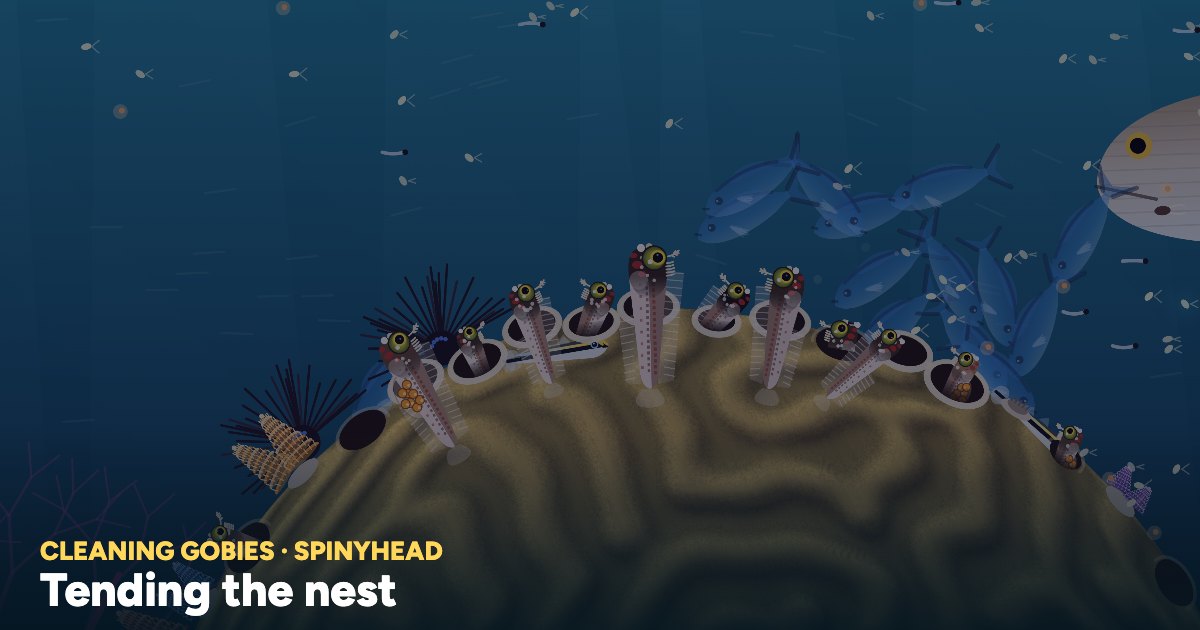
Behavior: Paternal care (male nest guarding of demersal eggs)
The male guards eggs laid in a small hole or crevice in dead coral, usually less than a metre from where he perches to clean.
Species involved
- sharknose goby Elacatinus evelynae male guards and tends the eggs in a crevice
About paternal care (male nest guarding of demersal eggs)
Paternal care means that a male, not the female, looks after the eggs after spawning. In many small reef fishes the female lays sticky, bottom-attached (demersal) eggs in a sheltered site such as a crevice, hole or empty shell. The male then stays near the clutch and defends it. Typical tasks are chasing off egg predators, keeping the eggs clean and keeping water moving over them. In the sharknose goby, the notebook describes the nest as a small hole or crevice in dead coral, usually less than a metre from the male's cleaning perch.
Why it matters
Eggs left alone on a reef are quickly eaten by egg-feeders and can suffer from fungus, silt and low oxygen. A guarding male therefore raises the share of eggs that hatch, which directly raises his reproductive success. Guarding has costs, because time spent at the nest is time not spent feeding, cleaning or seeking other mates. Nesting close to his home perch lets a male keep working while still watching the eggs, which may reduce that cost. Because the male protects the clutch, females may also choose mates partly on nest quality or on a male's record of guarding. The hatched larvae drift off in the plankton and are not looked after.
On coral reefs
A diver would see a small goby sitting on a coral head near its cleaning station and making short trips to a nearby crevice or hole in dead coral. Eggs in the nest are tiny and hard to see without close, patient watching. The male may dart out at small intruders near the entrance. Because nests are cryptic and the fish are only a few centimetres long, the behaviour is easy to miss.
Who studied it
Paternal care in fishes has been studied for a long time, and in teleosts it is more common than maternal care, especially in species with external fertilisation and nest sites. The notebook's source is Harding, Almany, Houck and Hixon (2003, Animal Behaviour 65:865), a study of the reproductive and cleaning biology of the sharknose goby on Caribbean reefs.
Elsewhere in the animal kingdom
Male egg guarding is widespread in fishes. Well-known examples are sticklebacks, which guard nests they build, many damselfishes, and blennies and other gobies that guard eggs in holes. In seahorses and pipefishes, males go further and carry the embryos in a brood pouch. Male mouthbrooding occurs in some cardinalfishes and in some catfishes.
Doubts and open questions
A long-standing question is why male-only care is so common in fishes, with explanations involving external fertilisation, territoriality and certainty of paternity. Guarding males sometimes eat part of their own clutch (filial cannibalism), and whether this is an energy-saving strategy or an error in handling eggs is still debated.
Related behaviors
- filial cannibalism The guarding male eats some of his own eggs instead of protecting all of them.
- cleaning symbiosis The goby removes parasites from client fish, which is a feeding behaviour that is separate from egg care.
- mate guarding The animal protects access to a mate before spawning, not the eggs after spawning.
- mouthbrooding A parent carries the eggs inside its mouth instead of guarding them in a nest.
- brood-pouch pregnancy in seahorses The male carries the embryos inside his own body instead of guarding eggs on the substrate.
Spinyhead is a free game you play in your browser: you are a spinyhead blenny, a fish about 3 cm long living in a worm hole on a Caribbean coral head. Feed, fight for a better hole, court, raise eggs and dodge predators, while everything around you behaves the way field biologists have seen it behave. Every behavior in the game is backed by a published study or careful observation; there are 38 on these pages, and more in the game’s field notebook waiting to be found.
More cleaning gobies
Other reef behaviors to discover