 SpinyheadPlay free
Flushed out
Behavior: Nuclear-follower foraging (a feeding association in which one predator flushes prey that others then catch), also called
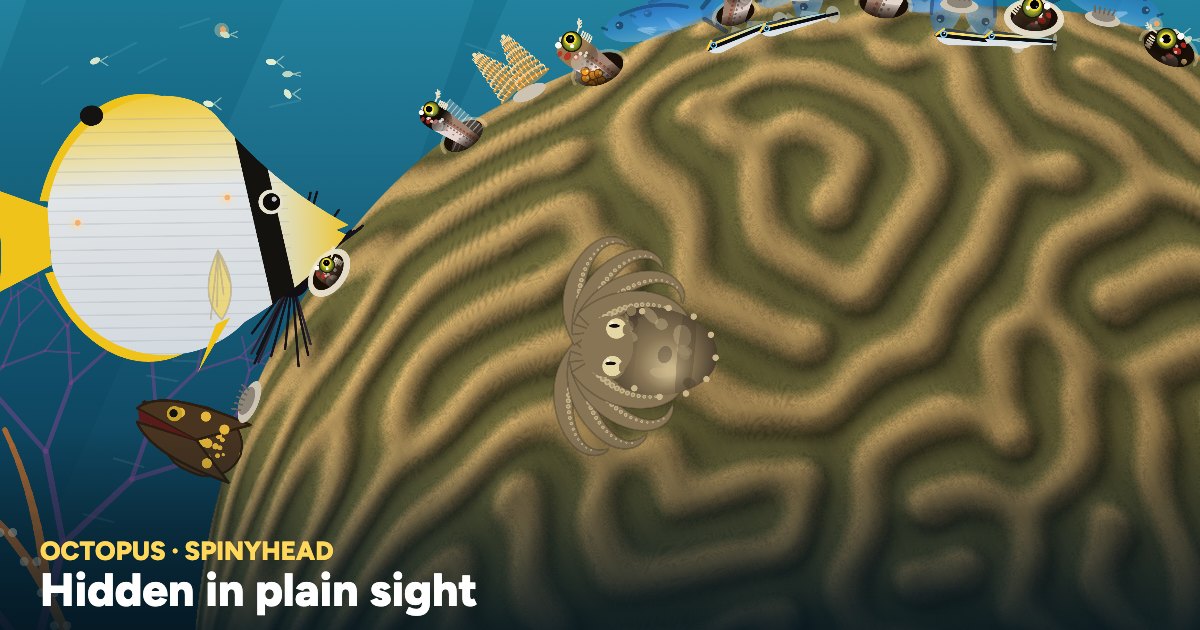
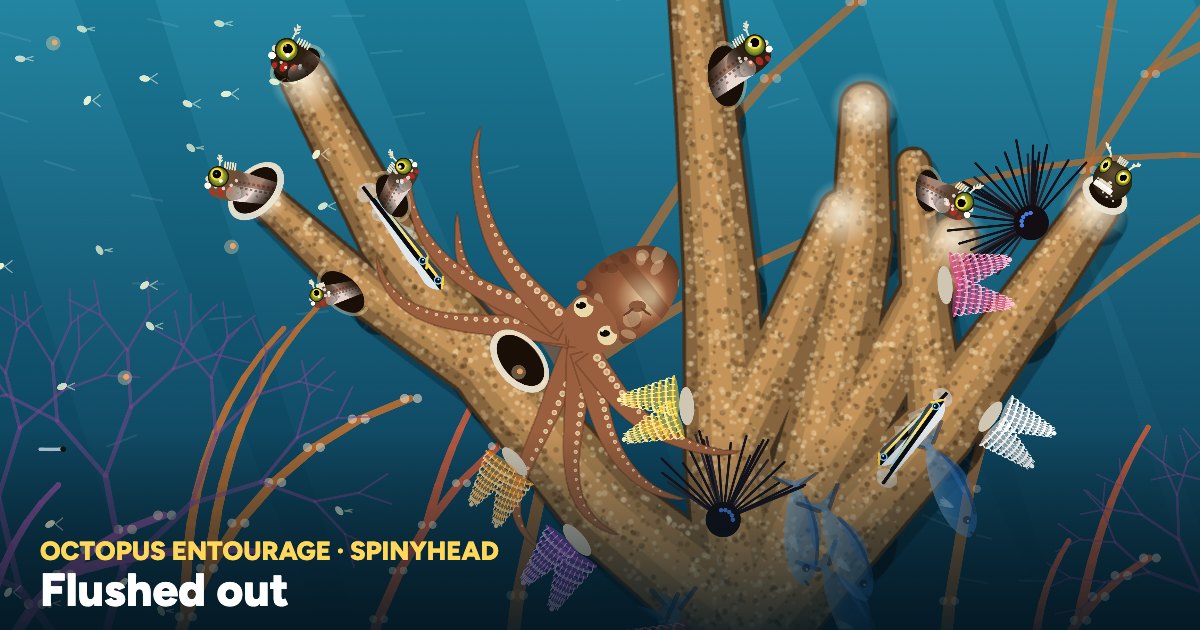
As the octopus feels into holes and cracks, shrimp, crabs and small fish bolt into the open, sometimes a blenny from a loose-fitting hole.
Species involved
- common octopus Octopus vulgaris nuclear forager that flushes prey from crevices
- spinyhead blenny Acanthemblemaria spinosa small fish that may be driven out of a loose-fitting hole
- graysby Cephalopholis cruentata possible predatory follower
- coney Cephalopholis fulva possible predatory follower
- schoolmaster snapper Lutjanus apodus possible predatory follower
About nuclear-follower foraging (a feeding association in which one predator flushes prey that others then catch), also called
In a nuclear-follower association, one species (the nucleus) disturbs hidden prey as it forages, and other species (the followers) trail it and catch what escapes. An octopus hunts by reaching its soft arms into holes and cracks and feeling for crabs, shrimp and small fish. Prey that bolt into open water become visible and exposed. The notebook describes this flushing, with small animals sometimes ejected from loosely fitting holes. The notebook gives no source. Which species follow the octopus is not stated here.
Why it matters
For followers, the association turns hidden prey into catchable prey at little cost, because the octopus does the searching. For the octopus, the effects are mixed. It may lose some prey to followers, and it may gain from extra vigilance, though that is not firmly established. For the flushed prey, a refuge becomes a trap. Hiding in a crevice protects against many predators but not against an arm probing inside. On the reef community level, such associations let predators with different hunting styles share one food supply. They can also raise predation on cryptic reef animals beyond what the octopus alone would cause.
On coral reefs
A diver may see an octopus moving over rubble or reef, probing holes with its arms. Fish such as groupers or snappers may hover close by or follow it. Small crabs, shrimp or fish suddenly dart out of crevices near the octopus, and a follower may lunge at them. The octopus often changes colour and texture as it moves.
Who studied it
Mixed-species groups that follow a nuclear forager have long been described in birds, mammals and fishes. For octopuses, field observers have reported fishes following foraging octopuses in several seas, and a few studies have documented these groups.
Elsewhere in the animal kingdom
Following associations are well known on land and sea. Egrets catch insects flushed by grazing cattle. Some tropical birds follow army ant swarms to catch the insects and other small animals the ants drive out. Fish such as goatfish are followed by other fishes that feed on prey the goatfish stir up. Groupers and moray eels are also known to hunt near each other, with the grouper intercepting prey the moray flushes.
Doubts and open questions
It is debated whether such associations are simple commensalism (followers benefit, the nucleus is unaffected) or closer to cooperation or even exploitation. Researchers have asked how much the octopus gains or loses. Octopuses sometimes appear to react to followers, and some reports describe them striking at fishes, but the details and how widespread this is remain uncertain, especially for Caribbean octopuses.
Related behaviors
- Cooperative hunting between species Both partners actively coordinate and benefit, as in grouper and moray hunting, rather than one simply exploiting the other's disturbance.
- Aggressive mimicry A predator deceives prey with a false signal, whereas flushing works by physical disturbance of hiding places.
- Kleptoparasitism The follower steals food the other animal has already caught, rather than catching prey the nucleus flushed out.
- Ambush predation The predator waits for prey to come to it instead of driving prey out.
Spinyhead is a free game you play in your browser: you are a spinyhead blenny, a fish about 3 cm long living in a worm hole on a Caribbean coral head. Feed, fight for a better hole, court, raise eggs and dodge predators, while everything around you behaves the way field biologists have seen it behave. Every behavior in the game is backed by a published study or careful observation; there are 38 on these pages, and more in the game’s field notebook waiting to be found.
Other reef behaviors to discover