SpinyheadPlay free
Off to the seagrass
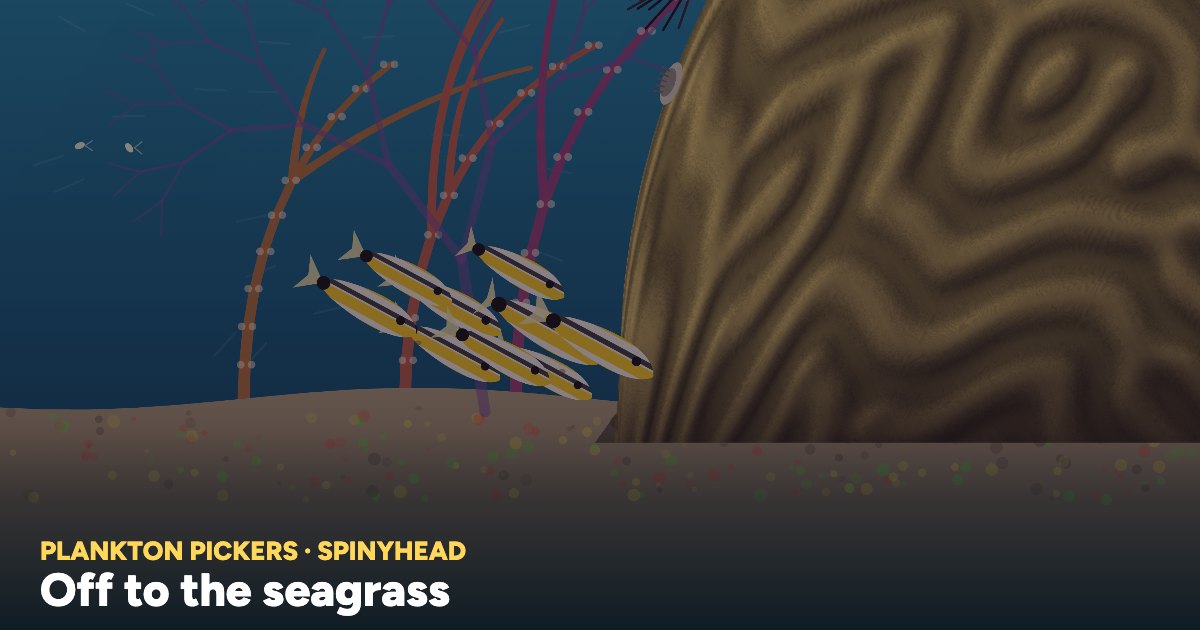
Behavior: Diel (nocturnal) feeding migration, also called daily or tidal-independent commuting between resting and feeding habitat
Juvenile grunts rest in schools on the reef by day. At dusk they leave together along the same route every evening to feed in the seagrass beds, and return at dawn.
Species involved
- French grunt Haemulon flavolineatum juveniles that rest on the reef by day and commute to seagrass to feed at night
About diel (nocturnal) feeding migration, also called daily or tidal-independent commuting between resting and feeding habitat
Many reef fishes divide their day between two habitats: a sheltered place to rest and a different place to feed. Juvenile French grunts spend the day in tight schools close to coral heads, then move off at dusk to forage over nearby seagrass beds and sand flats, and come back at dawn. The notebook entry notes that they follow the same route each evening. This is a regular, repeated daily movement of a few hundred metres or so, not a one-off migration or a change of home range.
Why it matters
Resting in a school beside coral gives safety in numbers and shelter from the many predators active in daylight, while the seagrass offers a rich supply of small invertebrates (such as crustaceans) to eat at night, when the grunts themselves are less exposed to sight-hunting predators. For the individual this balances growth against risk. The nightly movement also carries nutrients: food eaten in seagrass is excreted around the reef, where it can enrich the coral community, so the grunts act as a link between habitats. The use of fixed routes may help fish travel efficiently and safely, and routes can be learned from older fish.
On coral reefs
At midday a diver sees dense, motionless aggregations of small yellow-striped grunts hovering over coral heads or sea fans. Around dusk the groups become restless, line up and stream off toward sand and seagrass, often along the same path night after night. At dawn the same schools can be seen drifting back and settling into their resting places.
Who studied it
The behaviour was described in detail by Ogden and Ehrlich (1977, Marine Biology 42:273), the notebook's source, which studied the traditional migration routes of juvenile grunts between daytime reef shelters and night feeding grounds. Later work, notably by John Ogden and colleagues, explored how this movement transfers nutrients from seagrass beds to reefs.
Elsewhere in the animal kingdom
Daily feeding commutes between shelter and foraging areas are widespread. Other grunts and snappers on tropical reefs do much the same, while in other settings examples include roosting and foraging flights of bats and birds, and the daily vertical migration of zooplankton and their predators in the open ocean.
Doubts and open questions
It is still debated how fish learn and keep to the routes, and how much of the pattern is driven by predation risk compared with food supply. Whether the nutrient transfer from seagrass to reef matters much for coral growth varies by location and is still being studied.
Related behaviors
- diel vertical migration Animals, especially zooplankton, move up and down the water column daily instead of between habitats.
- ontogenetic habitat shift A permanent move between habitats as a fish grows, such as from seagrass nursery to reef, rather than a daily round trip.
- schooling Group swimming for safety and coordination, which the commuting grunts use but which can occur without any migration.
- homing and site fidelity Returning to a particular home site, which is part of this behaviour but is not limited to daily trips.
Spinyhead is a free game you play in your browser: you are a spinyhead blenny, a fish about 3 cm long living in a worm hole on a Caribbean coral head. Feed, fight for a better hole, court, raise eggs and dodge predators, while everything around you behaves the way field biologists have seen it behave. Every behavior in the game is backed by a published study or careful observation; there are 39 on these pages, and more in the game’s field notebook waiting to be found.
More plankton pickers
Other reef behaviors to discover