 SpinyheadPlay free
The moray abroad
Behavior: Nocturnal foraging (olfactory crevice hunting by morays)
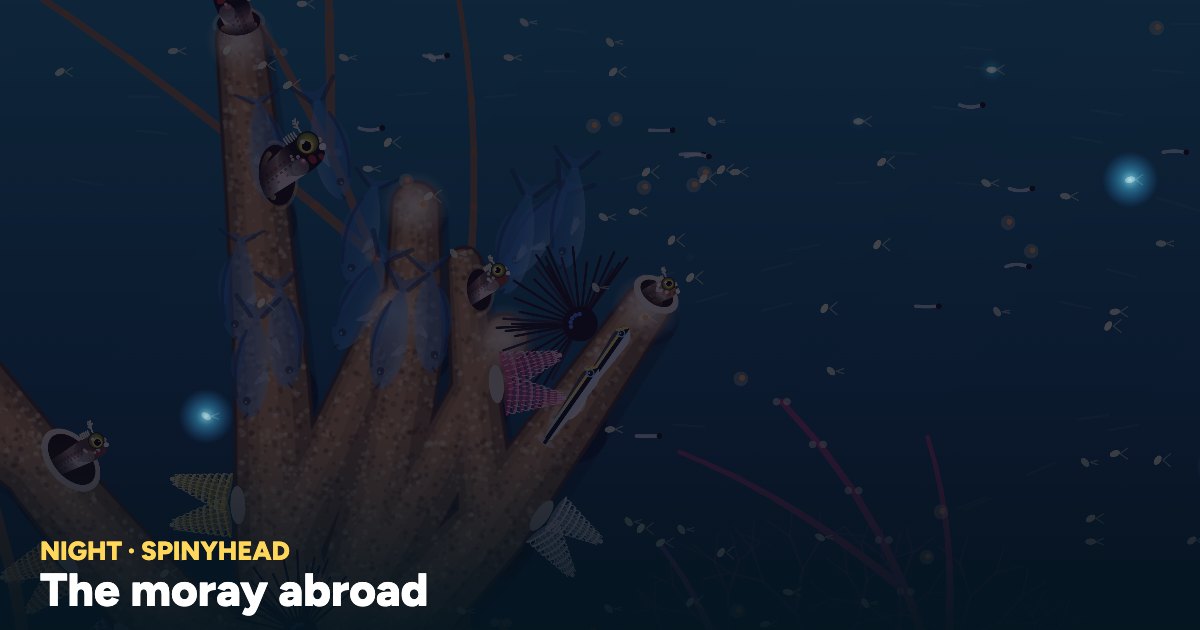
At night the moray leaves its den and hunts along the coral, probing crevices by smell for small fish and crustaceans.
Species involved
- spotted moray Gymnothorax moringa nocturnal predator hunting by smell in crevices
- goldentail moray Gymnothorax miliaris nocturnal predator hunting by smell in crevices
About nocturnal foraging (olfactory crevice hunting by morays)
Many reef predators are active mainly at night, and morays are a well-known example. By day they usually rest with the body hidden in a crevice or den and only the head showing. After dusk they leave the shelter and move over and through the reef framework. Morays have small eyes and rely heavily on a very good sense of smell, using their nostrils (tubular in many species) to detect prey odours, and they search holes and crevices where small fish and crustaceans shelter.
Why it matters
Hunting at night lets morays exploit prey that are hiding or inactive, and avoids the daytime competition and visual predators of the open reef. Their long, muscular, scaleless bodies let them reach into spaces that bigger visual hunters such as groupers and snappers cannot enter, so they take prey that is otherwise out of reach. For the reef community this means sheltering fish and crustaceans are still exposed to predation after dark, and morays add a different kind of predation pressure to that of day-active hunters. The foraging also takes place at a time when many other reef animals are changing shifts, which shapes who eats whom during the night.
On coral reefs
A diver at night may see morays out of their dens, swimming or sliding across the reef with the head swinging and poking into holes. By day the same animals are mostly seen with just the head out of a crevice, mouth opening and closing, which is breathing and not aggression. Night dives are the best chance of seeing them actively travelling over open reef.
Who studied it
Nocturnal activity of reef predators was recognised early by divers and reef biologists, who noted the reef's day and night shifts in which fishes are active. Moray feeding has been studied through gut contents and field observation, and their reliance on smell over sight is generally accepted.
Elsewhere in the animal kingdom
Night hunting guided by smell is widespread among predators. Many sharks, including nurse sharks, are well known for it, as are catfishes and eels in fresh water. On land, many nocturnal mammals such as hedgehogs and some snakes also hunt largely by scent.
Doubts and open questions
The details of how much morays use smell versus other senses are still being worked out, and some species and individuals also hunt by day. Moray species differ in diet, and the proportion of fish versus crustaceans depends on the species, so the notebook's description is a general picture and not true of every moray.
Related behaviors
- cooperative hunting between morays and groupers Some morays and groupers have been seen hunting in association, where one flushes prey from crevices and the other ambushes it, whereas here a moray hunts alone.
- ambush predation Ambush predators such as frogfish wait motionless for prey to come close, whereas the moray actively searches by smell.
- diel activity shifts This is the general pattern in which reef species are active at different times of day, of which the moray's night foraging is one example.
Spinyhead is a free game you play in your browser: you are a spinyhead blenny, a fish about 3 cm long living in a worm hole on a Caribbean coral head. Feed, fight for a better hole, court, raise eggs and dodge predators, while everything around you behaves the way field biologists have seen it behave. Every behavior in the game is backed by a published study or careful observation; there are 38 on these pages, and more in the game’s field notebook waiting to be found.
More night
Other reef behaviors to discover