SpinyheadPlay free
Eating in a bell
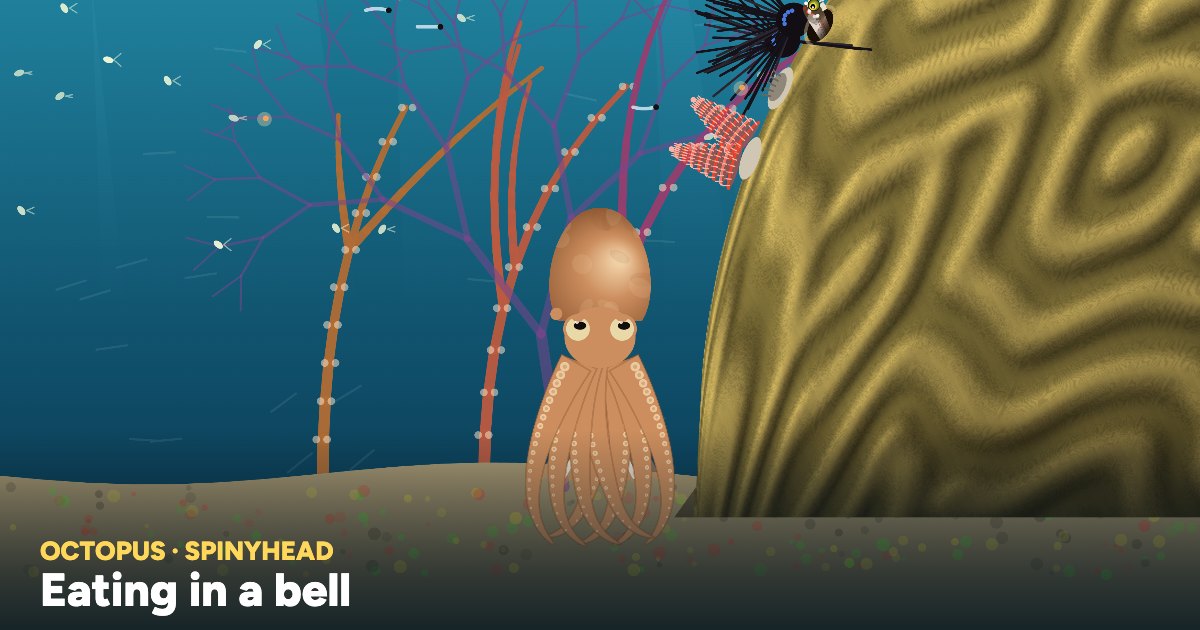
Behavior: Cannibalism (intraspecific predation), here an adult octopus capturing and eating a smaller octopus in a web-covered 'be
Still holding its prey, the adult settles to the bottom in a bell-shaped hold, the smaller octopus’s arm tips poking out, and changes to a mottled pattern while it eats. Octopus suckers can't actually grab and hold onto octopus flesh (likely so that they dont stick to themselves), this means the attacking octopus has to use muscle power to hold its prey in this bell shape with the constriction at the opening of the web between the attackers arms.
Species involved
- common octopus Octopus vulgaris adult predator, and the smaller octopus it eats
About cannibalism (intraspecific predation), here an adult octopus capturing and eating a smaller octopus in a web-covered 'be
Cannibalism is when an animal eats others of its own species. In octopuses it is a form of predation in which a larger individual catches a smaller one. An octopus typically pounces on prey and wraps its arms and the webbing between them around it. It then bites with its beak and eats in a sheltered spot. In the notebook scene the adult settles on the bottom and holds the smaller octopus inside the arm web in a bell shape, with the victim's arm tips sticking out through the opening. The adult shifts to a mottled colour pattern while it feeds.
Why it matters
Eating one's own species turns a competitor or neighbour into a meal, which can be a rich, easily handled food source. For the eater it can mean extra energy. For the victim it means death, so it is a strong source of mortality for small, young or weakened octopuses. At the population level it can limit crowding and shape which size classes survive, and it is one reason octopuses are often kept apart in aquaculture. Octopuses are largely solitary, soft-bodied and have short lives, so the risk of being eaten by a larger neighbour is a real pressure on them. The mottled pattern during the meal is probably a way to stay inconspicuous while the octopus is busy and exposed. The notebook only describes the pattern change and does not say why it happens.
On coral reefs
A diver would rarely see this. Octopuses are secretive, mostly hide in dens and crevices, and are often active at dusk or night. A sighting would probably be an octopus crouched on the sand or rubble, its arms drawn into a dome with something held underneath, and its skin patterned to blend with the surroundings. Discarded remains near a den are another sign of feeding.
Who studied it
Cannibalism in octopuses has been noted for a long time in both wild and captive animals. The notebook's source for this entry is Hernández-Urcera, Cabanellas-Reboredo, Garci, Buchheim, Gross, Guerra and Scheel (2019), published in the Journal of Molluscan Studies 85:354. The notebook draws on it for how the attacker holds and eats the prey. Separate research on octopus arm control has examined why octopus suckers do not stick to octopus skin.
Elsewhere in the animal kingdom
Cannibalism occurs across the animal kingdom. Well-known examples are sexual cannibalism in praying mantises and some spiders such as black widows, and tadpoles of some frogs and toads that eat smaller siblings. Some sharks, including sand tigers, have embryos that eat their siblings in the womb, and many fish eat their own eggs or young. Other cephalopods, such as squids and cuttlefish, are also known to eat their own kind.
Doubts and open questions
How common cannibalism is in wild octopuses is hard to judge, because most evidence comes from captivity or from rare observations. The suggestion that the suckers fail to grip octopus flesh to avoid sticking to themselves is described in the notebook as likely, not proven. There is also a question about the common octopus itself, which is now regarded as a complex of closely related species, so Caribbean animals may not all be the same species.
Related behaviors
- filial cannibalism A parent eats its own eggs or offspring, rather than an unrelated smaller member of its species.
- sexual cannibalism One partner, usually the female, eats a mate before, during or after mating.
- intrauterine cannibalism (adelphophagy) Embryos eat their siblings or unfertilised eggs inside the mother.
- predation on other species The octopus eats a different species, such as crabs or fish, instead of its own kind.
Spinyhead is a free game you play in your browser: you are a spinyhead blenny, a fish about 3 cm long living in a worm hole on a Caribbean coral head. Feed, fight for a better hole, court, raise eggs and dodge predators, while everything around you behaves the way field biologists have seen it behave. Every behavior in the game is backed by a published study or careful observation; there are 71 on these pages, and more in the game’s field notebook waiting to be found.
More octopus
Other reef behaviors to discover