 SpinyheadPlay free
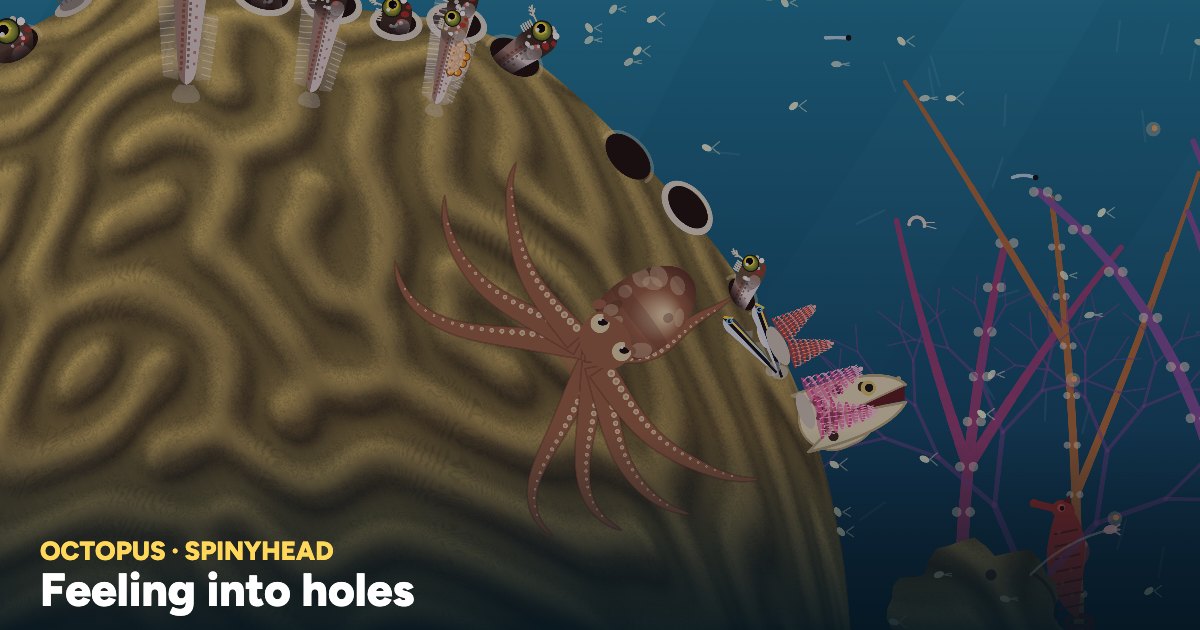
Feeling into holes
Behavior: Tactile foraging (probing holes and crevices for hidden prey)
A foraging octopus crawls over the reef, feeling into holes and crevices with its arms for anything hiding there. A fish in a snug hole is hard to pull out; in a loose one it is in danger.
Species involved
- common octopus Octopus vulgaris forager that searches by touch
- spinyhead blenny Acanthemblemaria spinosa small fish living in a hole, potential prey
About tactile foraging (probing holes and crevices for hidden prey)
Many bottom-living predators find hidden prey by touch and taste, not by sight. An octopus moves over the seabed and pushes its flexible arms into holes, crevices and gaps under rock and rubble. The suckers carry many chemical and touch receptors, so the arm can sense what is inside without the animal seeing it. Prey that is detected can be seized and drawn out, or the octopus can enclose the hole and flush the prey out.
Why it matters
For the octopus, probing exposes food that is invisible from outside, including crabs, other crustaceans, molluscs and fish sheltering in the reef. For the prey, a hole is a refuge only if it fits closely. A snug hole leaves little room for an arm to grip and gives the animal something to brace against. A loose or wide one gives the predator access. This favours prey that choose tight shelters and can pull themselves in or wedge themselves. At the community level, a roving, touch-hunting predator adds pressure on hole-dwelling animals that other predators, which hunt by sight and chase, do not reach.
On coral reefs
A diver may see an octopus creeping slowly over coral rock and rubble, often changing colour and texture as it goes. One or more arms are pushed into crevices and holes, sometimes deep, while the body stays outside. Often the arms are the only part moving. Other reef fish sometimes follow a foraging octopus to catch prey it disturbs.
Who studied it
Octopus foraging and its sensory basis have been studied for decades, including work on touch and chemotactile discrimination by octopus suckers and field observations of foraging in Octopus vulgaris. The notebook cites Hernández-Urcera, Cabanellas-Reboredo, Garci, Buchheim, Gross, Guerra and Scheel 2019 in the Journal of Molluscan Studies, volume 85, page 354. I am not certain of the details of that paper, so I do not summarise it here.
Elsewhere in the animal kingdom
Other octopus species and cuttlefish also search for hidden prey, and cuttlefish and squid use their tentacles to catch it. Moray eels hunt in crevices, but mainly by smell, not by reaching with limbs. Outside the sea, raccoons feel for prey under water and rocks with their forepaws, and probing shorebirds find buried prey by touch.
Doubts and open questions
It is not fully clear how much an octopus relies on touch, taste or sight at each stage of a hunt. The arms also have a large share of the animal's nerve cells and show partly local control, so how much of the probing is decided by the brain is an open question.
Related behaviors
- Ambush predation The predator waits, often camouflaged or lured, and lets prey come to it instead of searching for hidden prey.
- Cooperative hunting between species Different species hunt together and flush out prey for each other, whereas here a single animal finds prey by touch.
- Crevice sheltering (refuge use) This is the prey side: an animal uses a close-fitting hole to avoid predators, which is what probing tries to defeat.
Spinyhead is a free game you play in your browser: you are a spinyhead blenny, a fish about 3 cm long living in a worm hole on a Caribbean coral head. Feed, fight for a better hole, court, raise eggs and dodge predators, while everything around you behaves the way field biologists have seen it behave. Every behavior in the game is backed by a published study or careful observation; there are 71 on these pages, and more in the game’s field notebook waiting to be found.
More octopus
Other reef behaviors to discover