 SpinyheadPlay free
The swarm breaks up
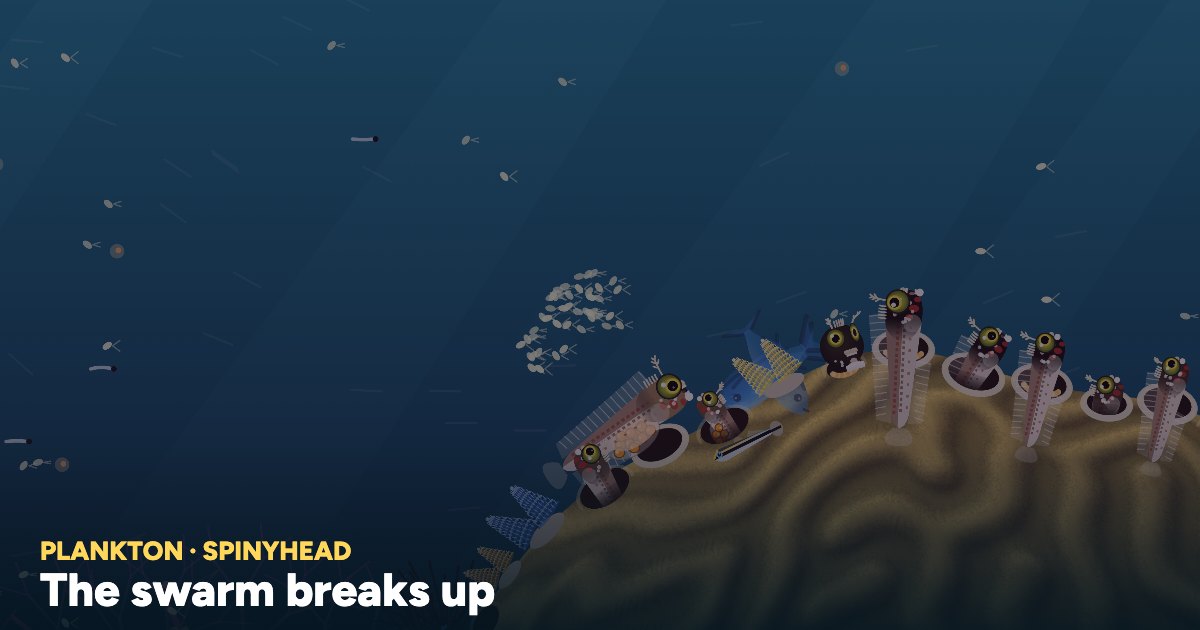
Behavior: Diel swarming of reef zooplankton (daytime copepod swarm formation and nocturnal dispersal)
Copepod swarms form by day and disperse at dusk, when the copepods scatter into the water column for the night.
Species involved
- planktonic copepods Copepoda form daytime swarms, then disperse at dusk
- blue chromis Chromis cyanea daytime planktivore that feeds on zooplankton in the water column
About diel swarming of reef zooplankton (daytime copepod swarm formation and nocturnal dispersal)
Some small crustaceans, including certain copepods, gather in dense, cohesive aggregations called swarms instead of drifting evenly spread through the water. Reef-associated species often form these swarms by day close to a structure such as a coral head, crevice or overhang. The swarm is a social grouping, not just a clump of animals trapped in the same current. At dusk the swarm breaks up and the individuals scatter through the water column, where they spend the night. The cycle repeats daily and is tied to the daily light cycle.
Why it matters
Why copepods swarm is not fully settled, but the main ideas are that swarming reduces losses to visual predators, helps animals stay near suitable habitat in moving water, and brings potential mates together. Dispersing at night, when visual predation is weaker, lets the copepods spread out and feed in open water. For the individual this is a trade-off between safety and feeding. For the reef, swarms concentrate a lot of small, energy-rich prey in particular places by day. Dispersal at night then moves plankton-derived energy through the water column and into the reef food web.
On coral reefs
By day a diver may see a hazy cloud or shimmering patch of tiny animals hanging just above or beside a coral head, a ledge or a crevice. Planktivorous fishes can be seen picking at the edges of such clouds. At dusk the patch loosens and fades as the animals spread out. At night the individuals are scattered and are mostly invisible without a light.
Who studied it
Reef copepod swarms were described in detail by W. M. Hamner and J. H. Carleton in 1979 in Limnology and Oceanography 24:1, the notebook's source. They documented swarms around coral reef structures, described their attributes and discussed their role in reef ecosystems. Later work on reef and mangrove zooplankton has built on the observation that many zooplankters occupy different places by day and by night.
Elsewhere in the animal kingdom
Swarming is widespread in small aquatic animals, for example Antarctic krill, mysid shrimps and Daphnia. Mating swarms of midges and mayflies are the familiar insect parallel on land. Diel vertical migration by zooplankton, up at night and down by day, is probably the best-known daily movement pattern in the open ocean.
Doubts and open questions
Researchers still debate whether swarming mainly serves predator avoidance, mating, feeding or staying near a habitat, and the reasons may differ between species. It is also unclear how much a swarm actually lowers predation, because swarms can attract predators.
Related behaviors
- diel vertical migration Zooplankton move up and down through the water column on a daily cycle, whereas swarming is about forming and dissolving a tight aggregation.
- schooling Fish schools are coordinated, polarized groups of swimmers, whereas copepod swarms are dense but less organized aggregations.
- mating swarms These form specifically to find mates, whereas reef copepod swarms may serve other functions as well.
- planktivory This is predators feeding on plankton, which is the pressure that may shape when and where swarms form.
Spinyhead is a free game you play in your browser: you are a spinyhead blenny, a fish about 3 cm long living in a worm hole on a Caribbean coral head. Feed, fight for a better hole, court, raise eggs and dodge predators, while everything around you behaves the way field biologists have seen it behave. Every behavior in the game is backed by a published study or careful observation; there are 71 on these pages, and more in the game’s field notebook waiting to be found.
More plankton
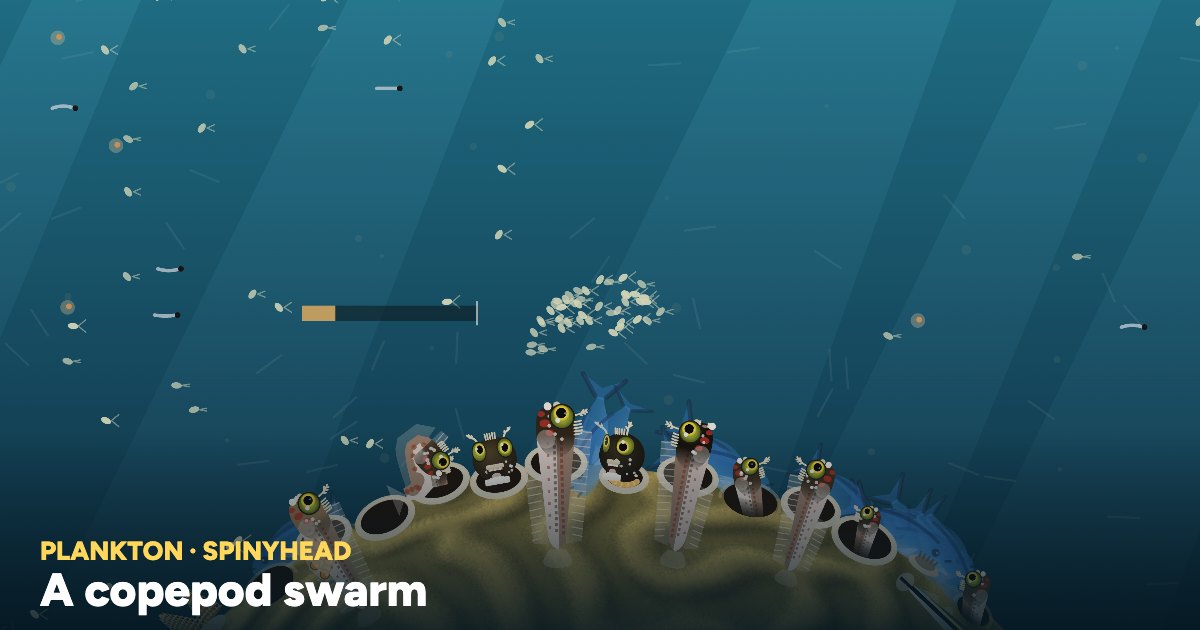
Other reef behaviors to discover