SpinyheadPlay free
Riding a grouper
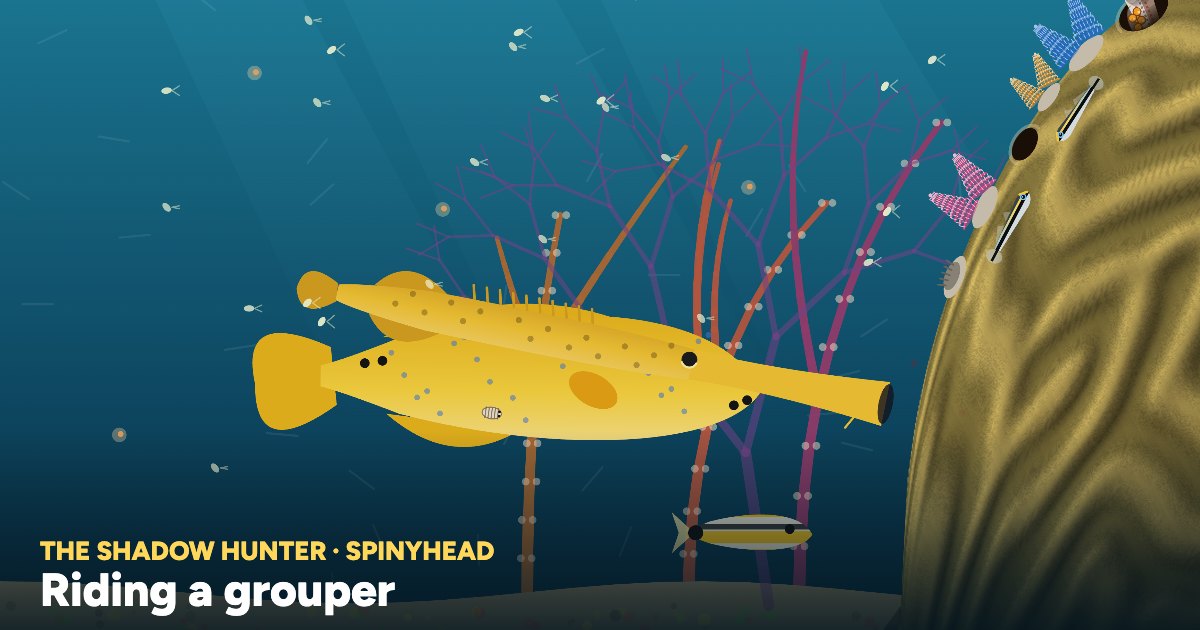
Behavior: Shadowing (hunting from behind a harmless heterospecific as moving cover), a form of aggressive camouflage
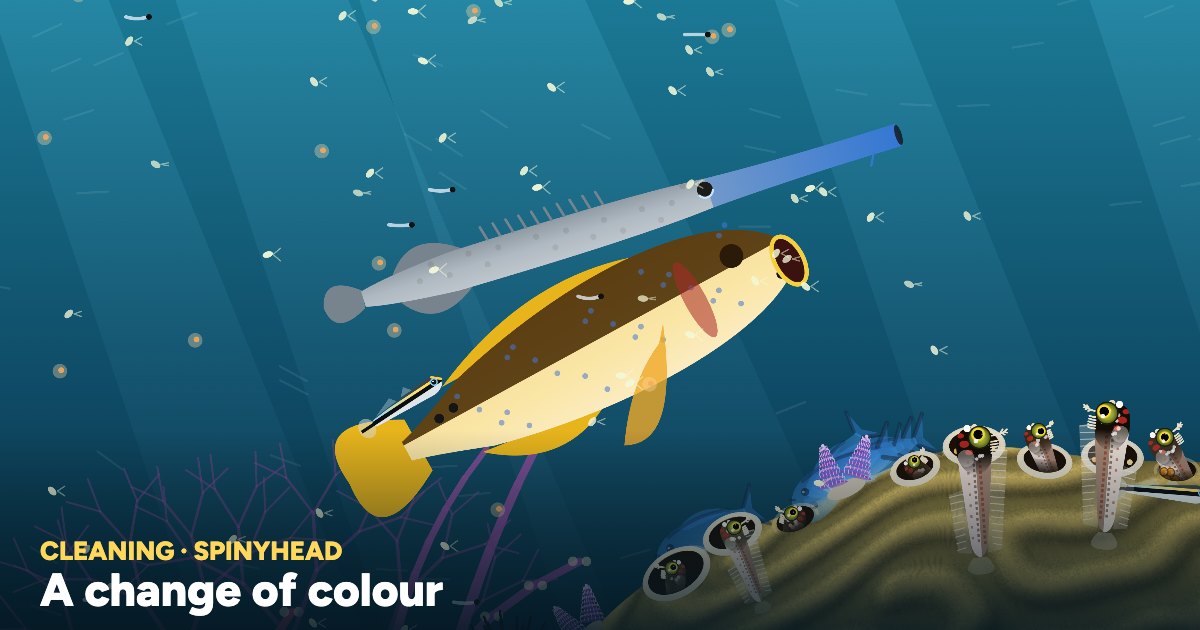
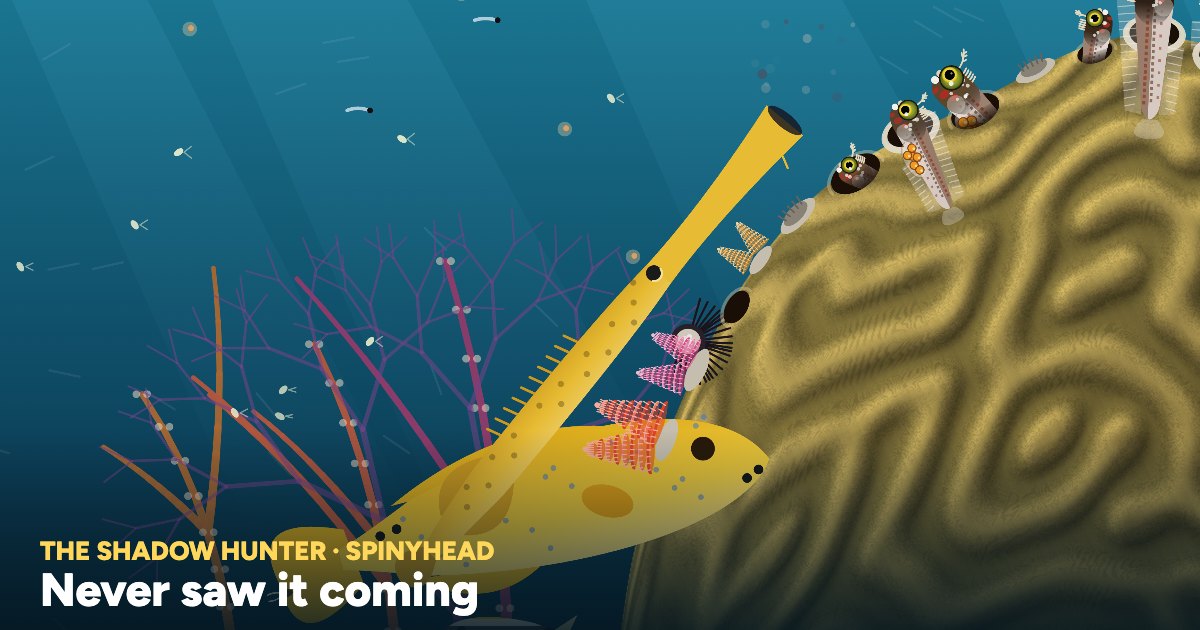
A trumpetfish lies tight along the back of a larger fish and swims with it. Its prey see only the harmless-looking escort, and the trumpetfish slides off to strike from point-blank range.
Species involved
- trumpetfish Aulostomus maculatus ambush predator that hides alongside an escort fish, then strikes
- graysby Cephalopholis cruentata larger fish used as the escort in this game entry (as a grouper)
- coney Cephalopholis fulva larger fish that could serve as the escort (as a grouper)
- blue chromis Chromis cyanea small fish that may be the prey being approached
About shadowing (hunting from behind a harmless heterospecific as moving cover), a form of aggressive camouflage
Shadowing is a hunting tactic in which a predator keeps its body close to another animal and moves with it, so that it is partly hidden or looks like part of that animal. The predator is not hiding in the habitat. It borrows a moving screen. Prey that would flee from a lone predator may tolerate the escort and let the hidden hunter come very close. The predator then leaves the escort's side and strikes from short range.
Why it matters
For the trumpetfish, the tactic shortens the distance to wary prey and reduces the chance of being spotted, so it can improve capture success for little energy. The escort usually gains nothing and is not obviously harmed. It is an unwitting accomplice, so this is exploitation rather than cooperation. The effects on prey are individual losses. Across a population, they may favour prey that treat even harmless-looking fish with caution. The notebook's wording is that prey see 'only the harmless-looking escort'. How well a given escort works depends on how much the prey fear it.
On coral reefs
A diver may see a long, thin trumpetfish pressed against the back or flank of a larger fish, often held in line with the escort's body. It drifts along at the escort's speed with almost no movement of its own. Then it darts out and snaps up a small fish. Published observations mostly describe large, non-predatory fish as the escorts. Groupers as escorts, as in this game entry's title, are a case to treat with some caution.
Who studied it
The notebook cites Aronson 1983 (Bulletin of Marine Science), a field study of how the West Atlantic trumpetfish uses large, mostly herbivorous reef fishes as camouflage when foraging. It also cites Matchette et al. 2023 (Current Biology), more recent work on predators exploiting the appearance or behaviour of other animals. The wider idea that predators use harmless animals as cover has been discussed for much longer.
Elsewhere in the animal kingdom
Trumpetfishes in other oceans, such as the Pacific trumpetfish Aulostomus chinensis, are also reported to hunt from behind other fishes. Other predatory fishes are described as using the same trick, and some mammals and birds use animals or objects as a screen to approach prey. The trumpetfish is among the best-known reef examples.
Doubts and open questions
It is not always clear whether the trumpetfish is truly hiding from prey or simply gets close to a fish that prey ignore. The choice of escort may also reflect other benefits, such as shelter from predators. Measuring how much shadowing actually raises capture success in the wild is difficult.
Related behaviors
- Aggressive mimicry The predator imitates a harmless or attractive object, such as the frogfish's lure, instead of hiding behind another animal.
- Nuclear-follower foraging Fish follow a digging or foraging species to snatch the prey it flushes, rather than using it as cover.
- Ambush predation from cover The predator waits motionless in habitat such as sea rods rather than moving with another animal.
- Cooperative hunting Two predators, such as a grouper and a moray, both gain from hunting together, whereas shadowing benefits only the shadower.
Spinyhead is a free game you play in your browser: you are a spinyhead blenny, a fish about 3 cm long living in a worm hole on a Caribbean coral head. Feed, fight for a better hole, court, raise eggs and dodge predators, while everything around you behaves the way field biologists have seen it behave. Every behavior in the game is backed by a published study or careful observation; there are 71 on these pages, and more in the game’s field notebook waiting to be found.
More the shadow hunter
Other reef behaviors to discover