SpinyheadPlay free
Trumpetfish Aulostomus maculatus

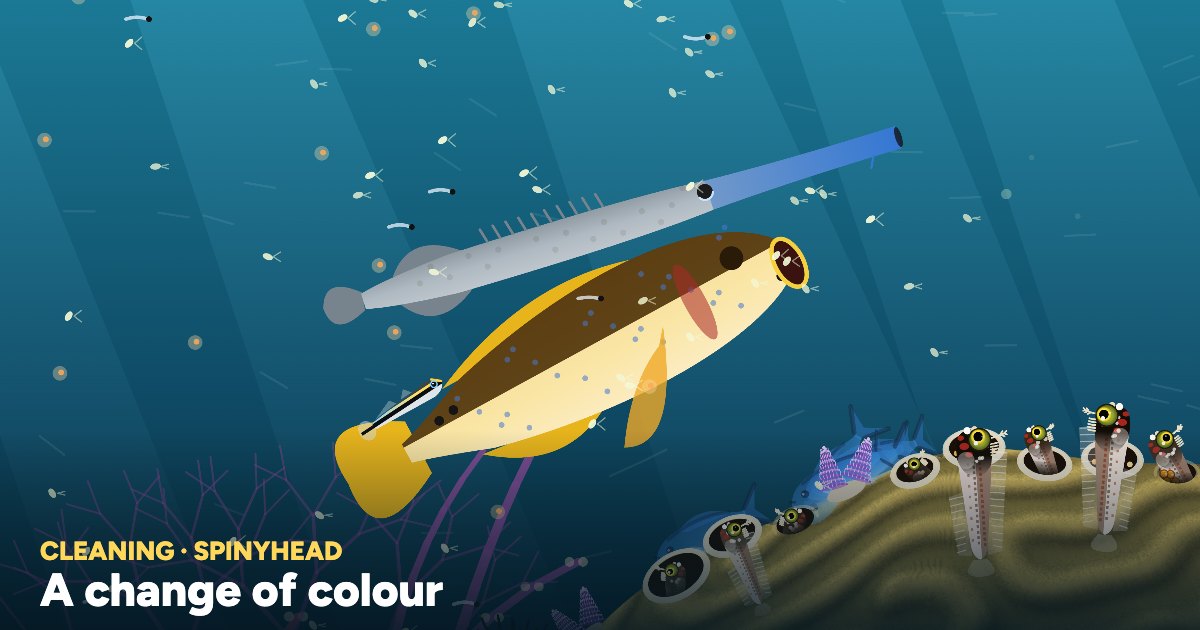
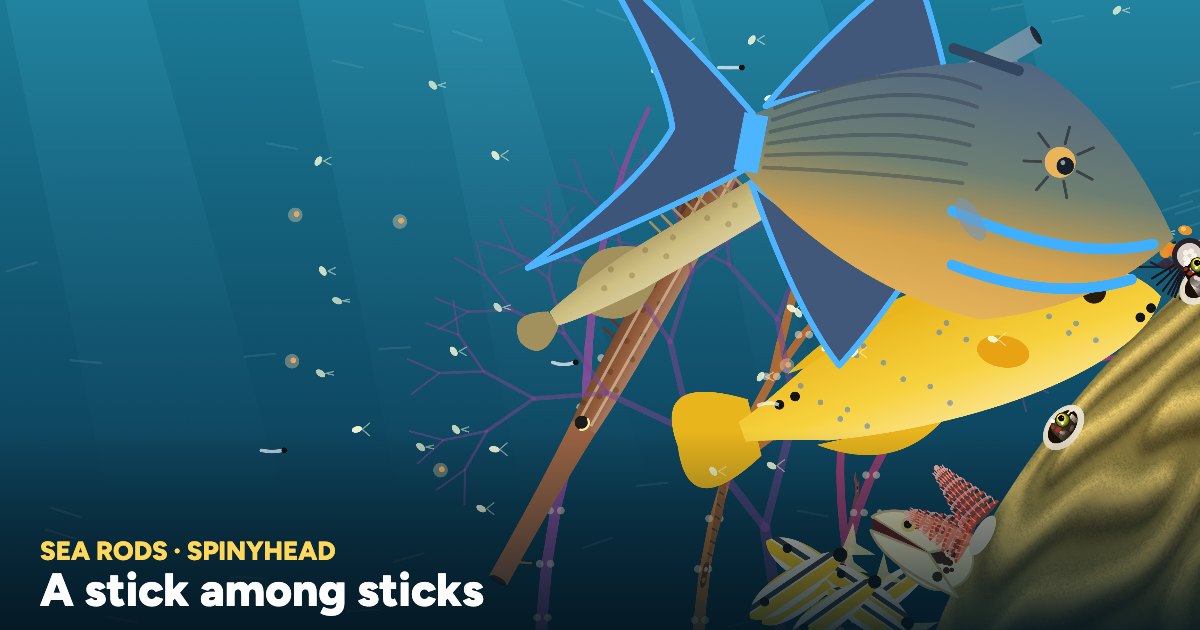
The trumpetfish is a long, slender, stick-like predator of Caribbean reefs, easily recognized by its tubular snout that ends in a small mouth. It often hangs motionless, frequently head-down, among sea whips, sea rods and other upright corals, where its shape blends in with the background. It can change color, and individuals range from brownish or grayish to bright yellow, with intermediate and mottled forms. It is an ambush predator that also uses other animals as cover when stalking prey.
How to recognize it
- very long, thin, rod-shaped body
- long tubular snout with small mouth
- small barbel on the lower jaw tip
- row of short dorsal spines before the soft dorsal fin
- dorsal and anal fins set far back near the tail
- variable color: brown, gray, or yellow
- pale stripes or spots along the body in many individuals
- often hovering vertically or head-down
| Size | Commonly about 40 to 80 cm long; maximum reported is about 1 m. |
|---|---|
| Range | Western Atlantic from Nova Scotia (rare strays) and Bermuda south through Florida, the Bahamas, the Gulf of Mexico and the Caribbean to northern South America. A closely related form occurs in the eastern Atlantic. |
| Habitat | Coral reefs, rocky reefs, seagrass beds and reef edges, usually near gorgonians and other vertical structures. Seen from very shallow water to roughly 25 m or more. |
| Diet | Eats mainly small fishes, and also some small shrimps and other crustaceans. It stalks prey slowly or waits motionless, then sucks them in with a rapid expansion of the snout and mouth. It sometimes drifts alongside larger, non-predatory fishes such as parrotfishes to approach prey unnoticed. |
| Conservation | Not considered threatened and is generally listed as Least Concern. It is fairly common on Caribbean reefs. Local declines could follow loss of reef habitat, and it is sometimes collected for the aquarium trade, but it is not a major fishery target. |
Life and behavior
Trumpetfish are mostly solitary and hunt by day, relying on camouflage and a sudden strike. They align their bodies with sea whips or similar structures to hide, and sometimes shadow other fishes as cover. They spawn as pelagic eggs, and the larvae drift in the plankton before settling on reefs. Details of growth and lifespan are not well documented. Color changes appear to relate to background and individual variation, and yellow fish are not a separate species.
Its family: Trumpetfishes (Aulostomidae)
Trumpetfishes are elongate, laterally compressed fishes with a long tubular snout and a small, toothless-looking mouth at its tip. They are ambush predators that feed on small fishes and invertebrates by suction. The family contains only a few species worldwide, found in tropical Atlantic and Indo-Pacific waters.
Similar species
- Cornetfish Fistularia tabacaria Even longer and thinner, with a flattened snout, a forked tail with a long central filament, and no row of dorsal spines. It usually swims in open water over sand and grass rather than hanging among gorgonians.
- Chinese trumpetfish Aulostomus chinensis A very similar species from the Indo-Pacific, not found in the Caribbean. Geographic range is the main difference.