SpinyheadPlay free
The graysby’s gulp
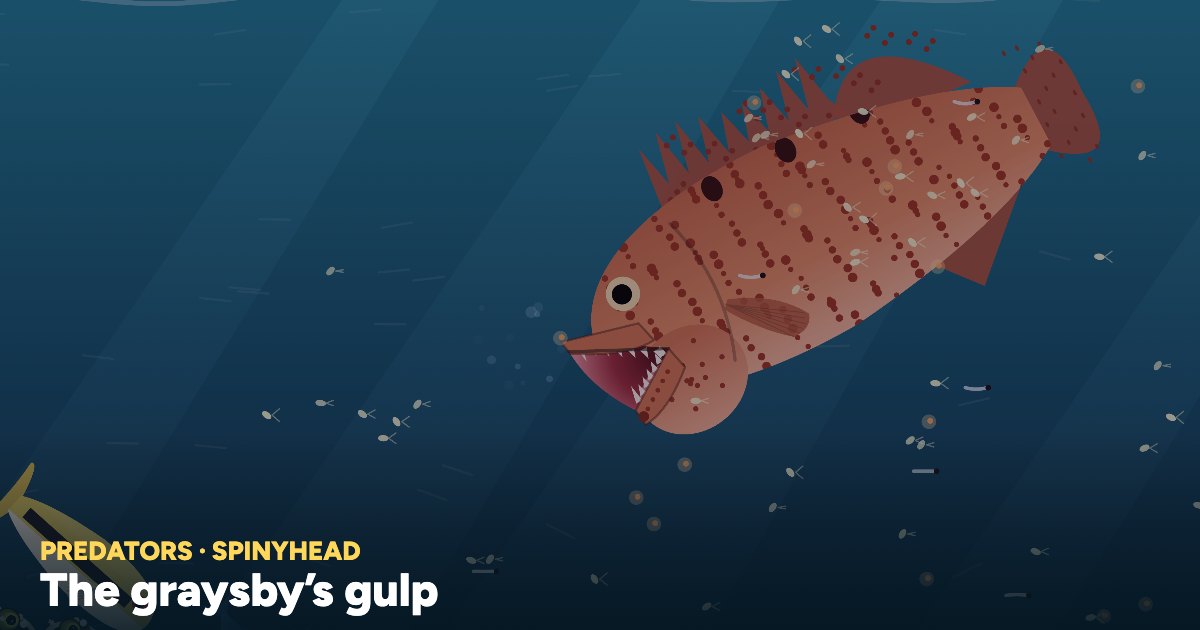
Behavior: Suction feeding (ambush predation by rapid buccal expansion)
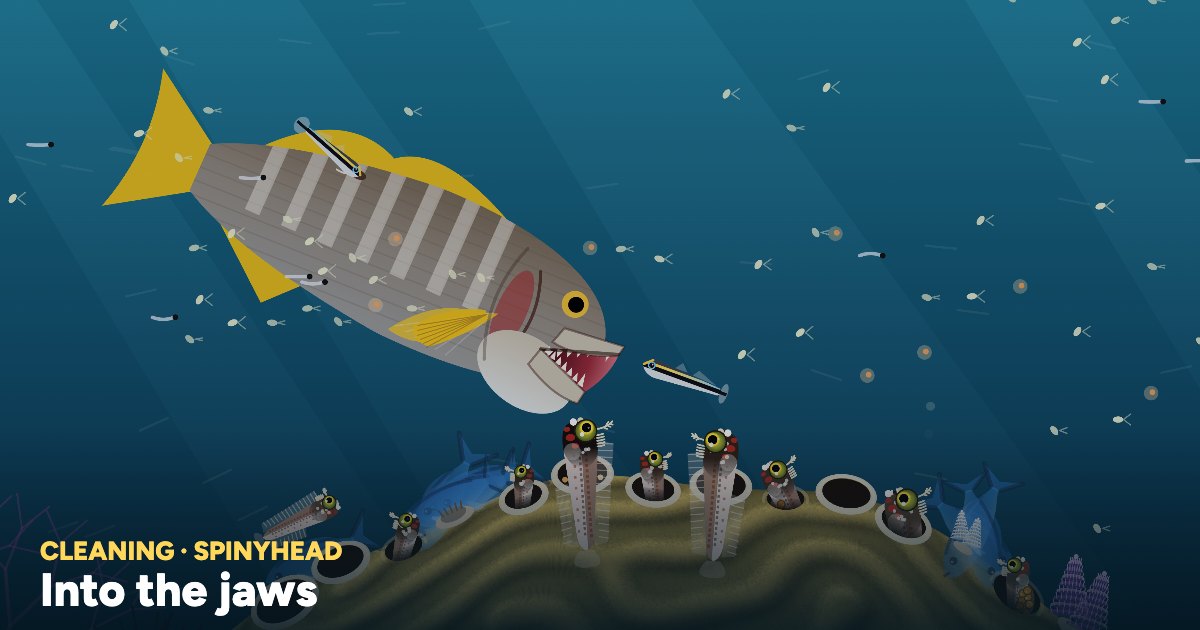
A graysby waits motionless, then expands its mouth and throat in a few hundredths of a second, sucking in prey with a rush of water.
Species involved
- graysby Cephalopholis cruentata sit-and-wait predator that engulfs prey by suction
About suction feeding (ambush predation by rapid buccal expansion)
Suction feeding is the main way most bony fishes capture prey. The fish rapidly expands its mouth cavity by opening the jaws, lowering the floor of the mouth, flaring the gill covers and often raising the skull. This drops the pressure inside the mouth and draws a rush of water, and anything small enough within it, into the mouth. The whole strike takes only a few hundredths of a second in many species. Groupers such as the graysby combine this with ambush: they rest motionless on or near the reef, then launch a short, fast strike.
Why it matters
Because water is dense and strikes are so fast, suction lets a predator catch evasive prey such as small fishes and crustaceans without a long chase, saving energy. Suction works only over a short distance, about a fraction of a mouth diameter in many fishes, so ambush predators must get close first, and stillness and camouflage matter. Large-mouthed groupers can engulf prey that is a substantial fraction of their own size. Predation by such fishes shapes the behaviour, habitat use and survival of small reef fishes, which tend to stay near shelter.
On coral reefs
A diver sees a graysby perched on a ledge, coral head or in a crevice, often perfectly still and well camouflaged by its mottled coloration. The strike is usually too fast to follow: a small fish is there one moment and gone the next, sometimes with a puff of displaced water or a slight flaring of the gill covers. Groupers often return to the same lookout spots.
Who studied it
The mechanics of fish suction feeding have been studied since the twentieth century using high-speed film and later high-speed video, with pressure sensors in the mouth. This work showed that the strike is a coordinated expansion of the mouth and throat that creates a short-lived flow of water into the mouth. The notebook entry gives no source, so no specific study is attributed here.
Elsewhere in the animal kingdom
Suction feeding is widespread in ray-finned fishes, including bass, catfishes, seahorses and pipefishes, frogfishes and many others. Seahorses and pipefishes use a rapid head rotation to bring the mouth to the prey before sucking it in, and frogfishes are among the fastest strikers known. Some aquatic salamanders and turtles, such as the mata mata, also use suction, as do some whales to a degree.
Doubts and open questions
Researchers still discuss how much of a strike's success comes from suction itself and how much from the predator's forward motion, known as ram, since most fishes combine the two. The balance varies between species, with groupers generally regarded as relatively suction-dominated, though the mix differs by prey and circumstances.
Related behaviors
- ram feeding The predator captures prey mainly by swimming onto it with an open mouth rather than by drawing water in.
- aggressive mimicry The predator lures prey close with a deceptive signal, as in frogfishes, rather than relying only on stillness and camouflage.
- biting or grasping feeding The prey is seized or scraped with the jaws and teeth, as in triggerfishes and parrotfishes, rather than engulfed with water.
- pivot feeding Seahorses and pipefishes rotate the head upward to reach the prey before suction, which differs from the straight-ahead strike of groupers.
Spinyhead is a free game you play in your browser: you are a spinyhead blenny, a fish about 3 cm long living in a worm hole on a Caribbean coral head. Feed, fight for a better hole, court, raise eggs and dodge predators, while everything around you behaves the way field biologists have seen it behave. Every behavior in the game is backed by a published study or careful observation; there are 71 on these pages, and more in the game’s field notebook waiting to be found.
More predators
Other reef behaviors to discover