SpinyheadPlay free
A father gives birth

Behavior: Male pregnancy (syngnathid brood-pouch care)
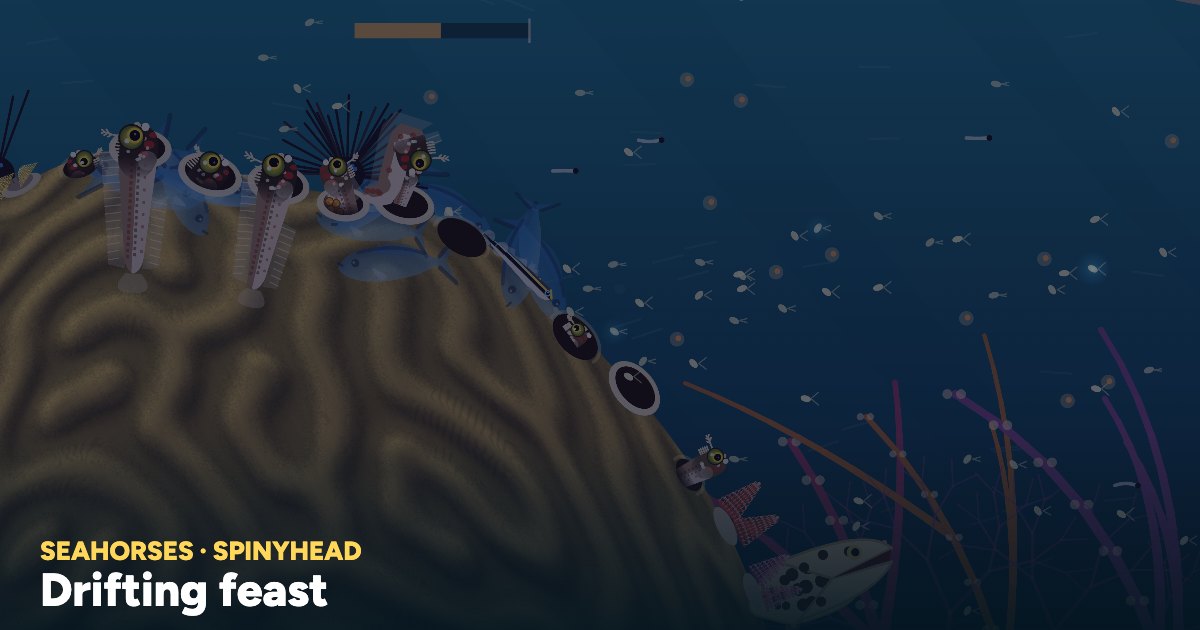
A male seahorse carries the eggs in his brood pouch until they hatch, then pumps the young out in bursts. Newborn seahorses swim up toward the light and drift away on the current.
Species involved
- longsnout seahorse Hippocampus reidi male carries eggs in a brood pouch and releases the young
About male pregnancy (syngnathid brood-pouch care)
Male pregnancy is a form of paternal care in which the female transfers her eggs into a specialised brood structure on the male, who fertilises, carries and nourishes them until they hatch. It is found only in the family Syngnathidae, which includes seahorses, pipefishes and seadragons. In seahorses the structure is an enclosed pouch on the male's belly (the trunk), sealed except for a small opening. The male's pouch lining is richly supplied with blood vessels and regulates the conditions around the embryos, including oxygen supply and salinity. At the end of the pregnancy the male contracts his body and pumps the fully formed young out in bursts, often described as giving birth.
Why it matters
Carrying the eggs protects them from predators and from fluctuating conditions, and the male can supply oxygen and a stable internal environment, so more of the brood survives. Because males are tied up with brooding, the time they need between broods can limit how often a population produces young. This changes the usual pattern of sexual selection, since the sex that is often in short supply is the one choosing and competing. In many seahorses and pipefishes this contributes to pair bonding and to females, not males, competing in some conditions. The newborns are tiny, receive no further care and disperse in the plankton, which spreads them between reefs and seagrass but exposes them to heavy mortality.
On coral reefs
Divers usually see seahorses clinging by their prehensile tails to gorgonians, sea whips, seagrass or other structure, and pregnant males can be recognised by a swollen, rounded belly. Pairs may be seen close together, and morning greetings between a male and female have been reported in some seahorse species. Birth and the release of young generally goes unseen because it takes place hidden among the structure, often at night or around dawn.
Who studied it
Male pregnancy in syngnathids has been known to naturalists for a long time, and the pouch was described in detail in the 19th and 20th centuries. Modern work has looked at the physiology of the pouch, mating systems and sex roles in seahorses and pipefishes. The notebook's source, Foster & Vincent 2004 in the Journal of Fish Biology, is a review of seahorse biology, conservation and management, covering their life history, including the reproduction described here.
Elsewhere in the animal kingdom
True male pregnancy with an internal pouch is unique to syngnathid fishes, but paternal care of eggs occurs widely in fishes, such as in damselfishes, gobies, sticklebacks and blennies, where males guard or fan the nest. Mouthbrooding by males, as in some cardinalfishes and cichlids, is another form of male carrying. Among other animals, the midwife toad and the Darwin's frog carry eggs or young on or in the male's body, but these are not pregnancy in the syngnathid sense. Seadragons carry eggs on the tail of the male instead of in an enclosed pouch.
Doubts and open questions
Researchers still debate how closely male pregnancy resembles mammalian pregnancy, for example how much nutrition besides oxygen is passed to the embryos and how this differs between species with simple and fully enclosed pouches. It is also discussed whether paternal brooding evolved because of the advantages for offspring survival or because of mating-system pressures.
Related behaviors
- mouthbrooding One parent carries the eggs or young in its mouth rather than in a sealed body pouch.
- paternal nest guarding The male guards or tends eggs attached to a nest site rather than carrying them on his body.
- viviparity Embryos develop inside the mother's body and are born live, as in many sharks, instead of in a male's pouch.
- sex-role reversal Females compete more strongly for mates than males, which can follow when males invest heavily in care.
Spinyhead is a free game you play in your browser: you are a spinyhead blenny, a fish about 3 cm long living in a worm hole on a Caribbean coral head. Feed, fight for a better hole, court, raise eggs and dodge predators, while everything around you behaves the way field biologists have seen it behave. Every behavior in the game is backed by a published study or careful observation; there are 71 on these pages, and more in the game’s field notebook waiting to be found.
More seahorses
Other reef behaviors to discover