SpinyheadPlay free
Copepod escape

Behavior: Hydromechanical predator detection and escape response (copepod escape jump)
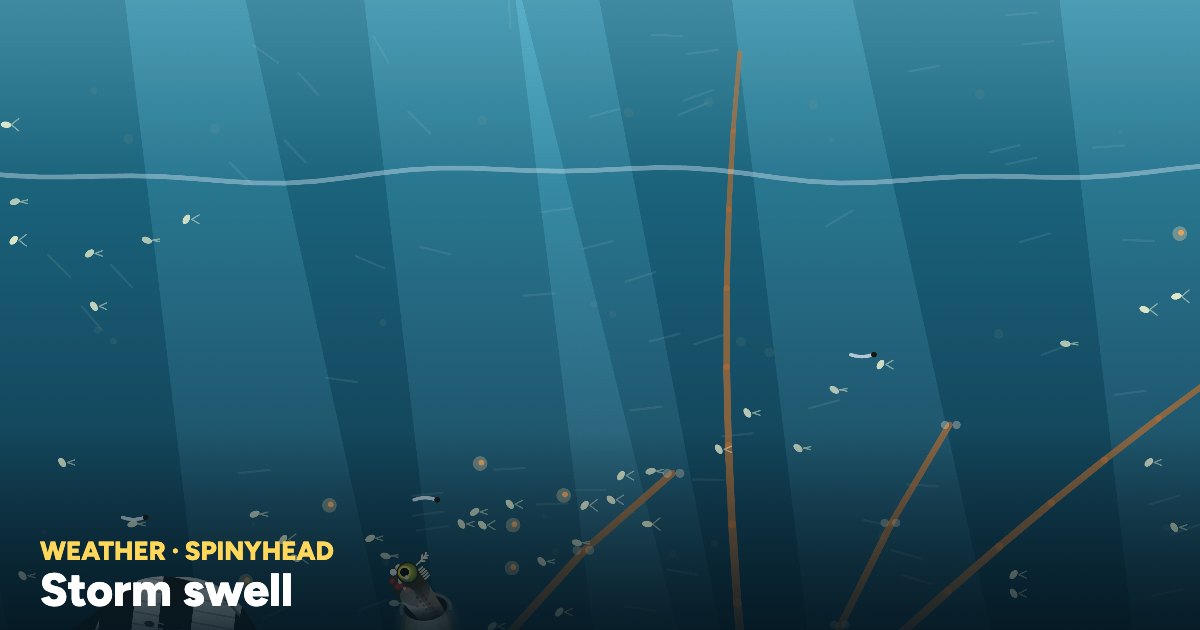
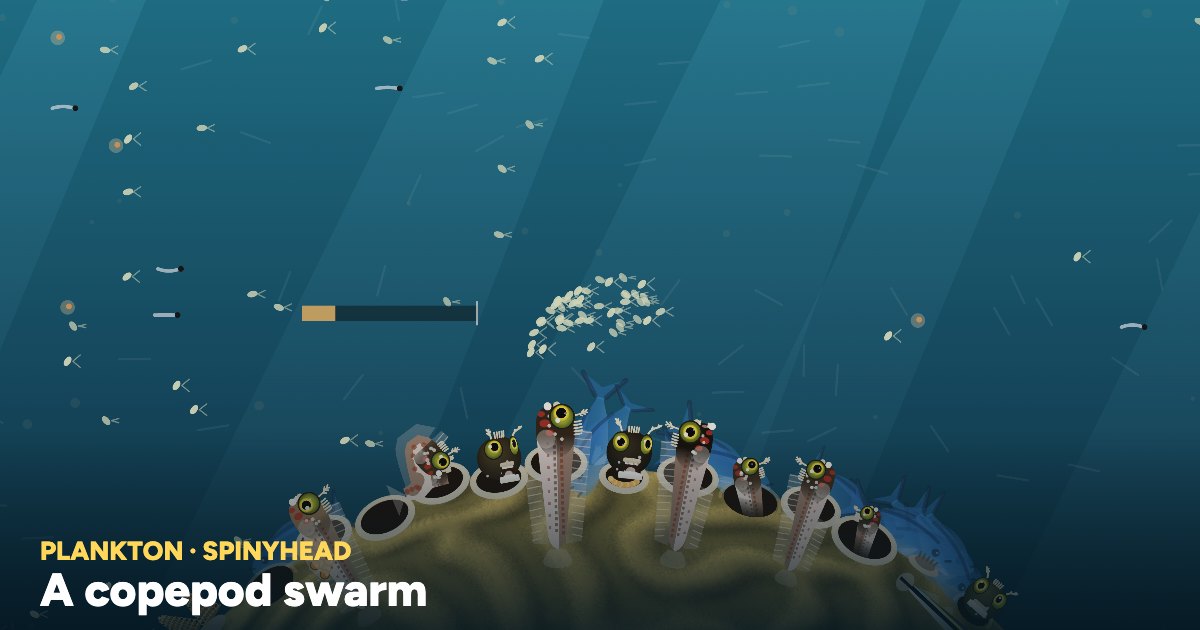
A calanoid copepod feels the bow wave of a striking fish through sensory hairs on its antennae and leaps clear in a few thousandths of a second. In still water most escape; turbulence masks the predator’s approach.
Species involved
- planktonic copepods Copepoda prey that sense the strike and jump away
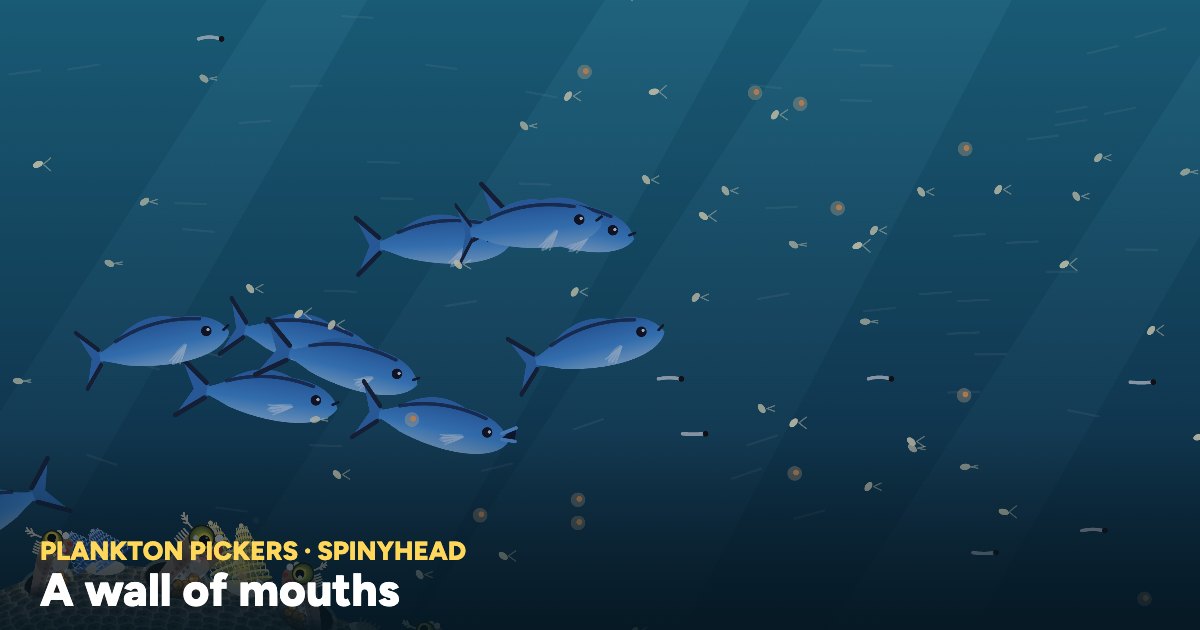
- blue chromis Chromis cyanea planktivorous fish that strikes at copepods
- bluehead wrasse Thalassoma bifasciatum plankton-feeding fish that is also a possible predator
About hydromechanical predator detection and escape response (copepod escape jump)
Many small planktonic crustaceans, calanoid copepods among them, detect approaching predators by the water movement the predator pushes ahead of it. Fine mechanosensory hairs (setae) on the long first antennae respond to small distortions of the flow. The signal triggers a rapid reflex in which the swimming legs and body produce a sudden jump, so the copepod covers many body lengths in a very short time. The reaction takes only a few milliseconds from stimulus to movement. It is among the fastest known in any animal for its size.
Why it matters
For the copepod, a successful jump is the difference between living and being eaten, and the speed of the reflex is strongly shaped by predation. For the fish, it means that plankton feeding is not simply opening the mouth. A planktivore has to approach gently, strike fast, or exploit conditions in which the copepod cannot read the signal. Detection depends on the water: in still water the bow wave is easy to feel and many copepods escape, while turbulence adds background flow noise that masks the approach, so strikes succeed more often. Water motion on the reef therefore affects which prey are catchable and where and when planktivores feed well. Because copepods are a major link between plankton production and reef fish, these capture rates matter for the wider food web.
On coral reefs
A diver sees planktivores such as chromis and juvenile wrasses hovering above the reef and picking at the water column, with sudden darting strikes. The copepods are almost invisible and their escapes cannot be seen with the naked eye. What can be seen is the fish lunging, often missing, and feeding more actively in surge and current, when the water is turbulent and the prey are easier to catch.
Who studied it
Escape reflexes in copepods have been studied since the mid-20th century, and later work using high-speed video, notably by Kiørboe, Buskey and colleagues, showed how flow signals trigger them and how quickly. Source is Clarke, Buskey and Marsden 2005 in Marine Biology 146:1145, which looked at how water motion and prey behaviour affect the capture of zooplankton by reef fishes.
Elsewhere in the animal kingdom
Fast reflexive escapes from flow cues are widespread. Fish have the C-start escape, driven by large Mauthner neurons in the brain stem, and detect strikes with the lateral line. Crayfish and other crustaceans have the tail-flip. Cockroaches and crickets sense air movement with hairs on their rear appendages (cerci) and run from approaching predators. Squid and other cephalopods jet away with giant-axon-driven contractions.
Doubts and open questions
The relative importance of different cues, such as the pressure signal, fluid deformation, vision and chemical cues, varies among copepod species and fish predators, and the details are still being worked out. How much turbulence actually reduces predator success on real reefs, as opposed to in lab or tank experiments, is not fully settled.
Related behaviors
- C-start escape response The same kind of fast reflex, but in fish and amphibians, where Mauthner neurons trigger a sharp body bend away from the stimulus.
- predator confusion in schools A group-level defence in which many moving prey make it harder for the predator to target one, rather than an individual reflex.
- crypsis The prey avoids detection by blending in instead of fleeing once a predator is already attacking.
- suction feeding The predator's side of the interaction, in which the fish draws prey in with a rapid mouth expansion, creating the flow that copepods try to detect and escape.
Spinyhead is a free game you play in your browser: you are a spinyhead blenny, a fish about 3 cm long living in a worm hole on a Caribbean coral head. Feed, fight for a better hole, court, raise eggs and dodge predators, while everything around you behaves the way field biologists have seen it behave. Every behavior in the game is backed by a published study or careful observation; there are 38 on these pages, and more in the game’s field notebook waiting to be found.
Other reef behaviors to discover