 SpinyheadPlay free
Sea rods (gorgonians) Plexauridae
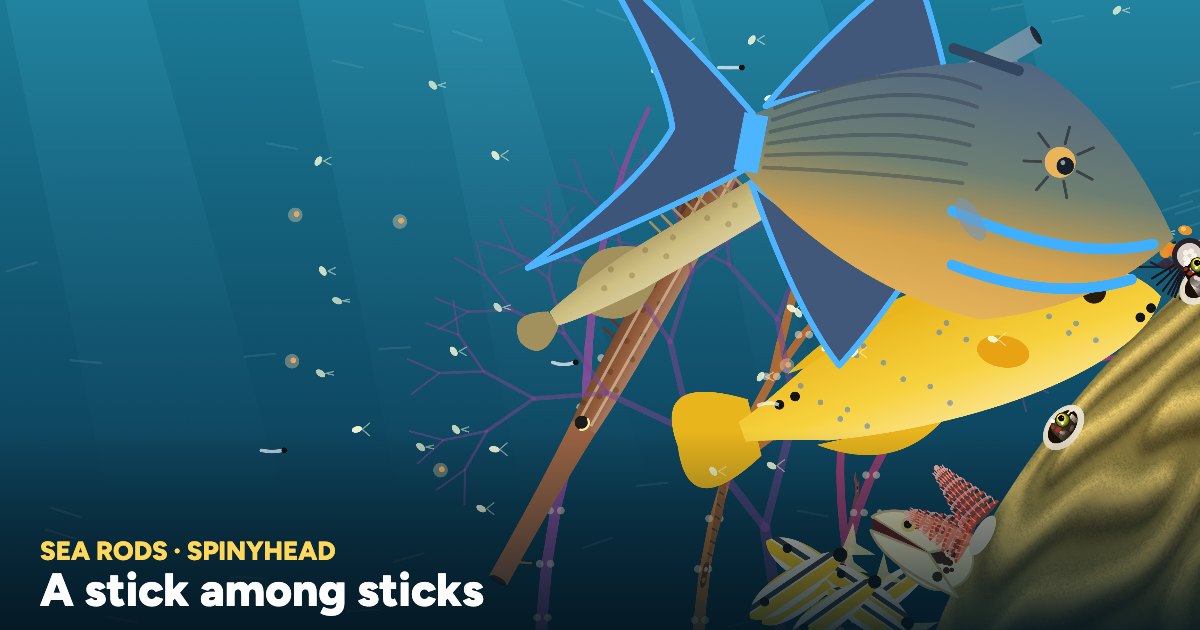
Sea rods are soft-bodied, tree-like octocorals that make up much of the 'underwater forest' on shallow Caribbean reefs. Each colony is a branching, flexible skeleton of horny protein covered by a living skin of tiny polyps. The colony bends and sways with passing surge rather than standing rigid like a stony coral. Most species are brown, tan, purplish or grayish, and when the polyps are open the branches look fuzzy. Plexaura flexuosa, the bent sea rod, is a typical and widespread example.
How to recognize it
- upright branching colony
- thick, rod-like flexible branches
- few to many branches off a holdfast
- brown, tan, or purplish color
- fuzzy look when polyps are open
- small bumps or pores when polyps retract
- eight feathery tentacles per polyp
| Size | Colonies are typically about 30 cm to 1 m tall. Some species reach about 1 m or a little more. Branches are usually under a few centimeters thick. |
|---|---|
| Range | Tropical western Atlantic: southern Florida, the Bahamas, and throughout the Caribbean. Members of the family also occur elsewhere in warm seas. |
| Habitat | Shallow reefs, reef flats, and hardbottom, usually attached to rock or dead coral. They are especially common in the zone where waves and surge are present, from near the surface to about 30 m or more. Different species favor different depths and amounts of water motion. |
| Diet | Sea rods feed in two ways. Symbiotic algae (zooxanthellae) in their tissue supply much of their energy through photosynthesis. The polyps also catch small plankton and particles with their tentacles and may take up dissolved organic matter. |
| Conservation | Most Caribbean sea rods have not been individually assessed for conservation status. They are threatened by coral disease, bleaching, storm damage, pollution, and general reef decline. Some Caribbean reefs have seen gorgonians persist or become more dominant as stony corals decline. Some species in the family were historically harvested for natural compounds, which is no longer a major threat. |
Life and behavior
A colony is made of many genetically identical polyps that share a common skeleton and tissue. Many sea rods are either male or female, and many Caribbean species release eggs and sperm into the water in synchronized spawning events, often in summer around the full moon. Fertilized eggs develop into swimming larvae that settle on hard surfaces and grow into new colonies. Colonies can also spread when broken fragments reattach and keep growing. Growth is generally moderate, and large colonies can be many years old. Many species make chemicals that discourage predators and neighbors.
Its family: Sea rods (Plexauridae)
Plexauridae is a large family of octocorals, many of them common on Atlantic and Caribbean reefs. Colonies are branching, with a flexible horny central axis and a living outer layer that holds tiny calcium carbonate spicules. Each polyp has eight tentacles and retracts into small openings in the colony surface. The shape of these openings and the spicules help separate genera and species, which can be hard to tell apart underwater.
Similar species
- Porous sea rod Pseudoplexaura porosa Branches are usually thicker, and the polyp openings are larger and more obvious when the polyps retract. The colony often looks heavier and bushier.
- Slit-pore sea rod Plexaurella nutans Colonies are stiffer, with few or no branches, and the polyp openings are slit-shaped.
- Common sea fan Gorgonia ventalina The colony is a flat, lacy fan, not a set of separate rods. It belongs to a different family (Gorgoniidae).
- Knobby candelabrum Eunicea calyculata Branches are more upright and candelabra-like, and the surface is covered with raised, knobby polyp mounds. It is a related Plexauridae.